China Top Coil Spring Manufacturers and Suppliers

Coil Spring manufacturers serve a demanding market shaped by vehicle production, industrial equipment, and replacement needs. Supplier selection is not just a price comparison. It involves material consistency, spring design, fatigue performance, and dependable delivery.

The International Organization of Motor Vehicle Manufacturers (OICA) reported that global motor vehicle production reached approximately 93.5 million units in 2023. This figure offers useful context for automotive component buyers, though it does not measure coil spring demand directly. A spring’s performance depends on its application, load range, operating temperature, and exposure to repeated stress. Small differences matter. A spring that looks right on a drawing may still fail to meet service requirements.

China’s manufacturing base includes suppliers producing suspension springs, compression springs, and custom-formed parts. Buyers should examine technical capabilities, material traceability, process controls, and documented testing before placing an order. Ask how suppliers verify dimensions and manage batch consistency. Request relevant certifications and test records, then confirm that they match the intended application. Certifications alone are not proof of product performance.

This guide introduces China’s top coil spring manufacturers and suppliers as a starting point for research. Supplier rankings can change, and public information may not reveal every production limitation. That deserves attention. Treat specifications, samples, and direct factory discussions as part of a careful evaluation—not as optional steps.
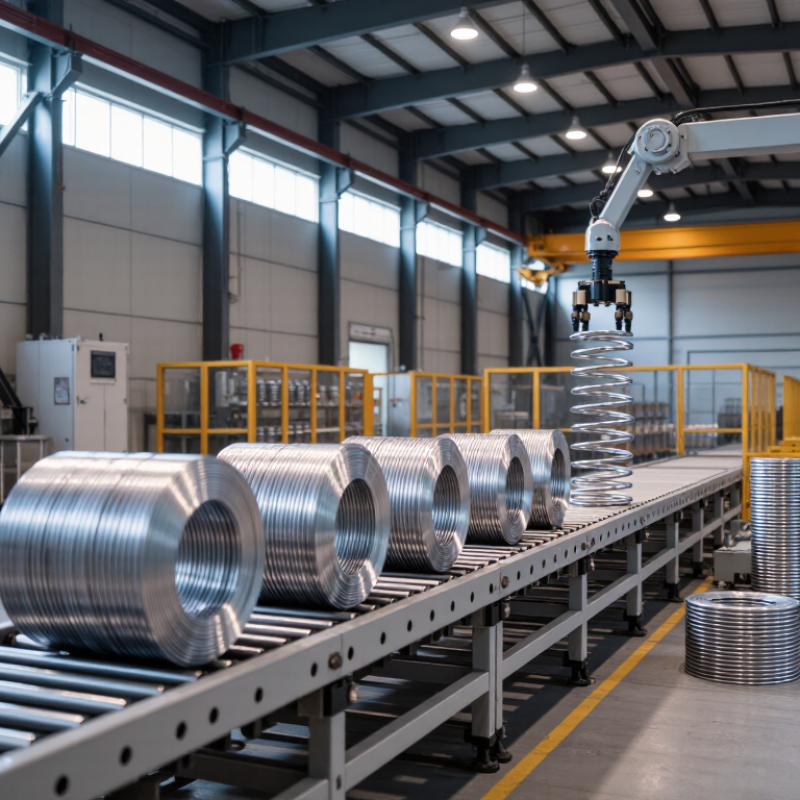
China Top Coil Spring Manufacturers and Suppliers

What Coil Springs Are and How They Work

A coil spring is a shaped length of elastic metal wire designed to compress, extend, or twist under load. In a vehicle suspension, a compression spring sits between the chassis and wheel assembly. When a tire crosses a pothole, the spring shortens and stores some of the impact energy. It then expands, helping the wheel follow the road while supporting the vehicle’s weight. The wire’s diameter, coil spacing, material, and overall shape all affect its stiffness and working range.

The movement is controlled, not magic. A damper slows the spring’s repeated bouncing, while the spring carries much of the vertical load. Too soft, and a vehicle may sag or bottom out over a sharp bump. Too stiff, and small road imperfections can feel harsh.

Engineers choose spring rates for the expected load, available space, and operating conditions. In practical inspections, uneven ride height, broken wire, or metal-on-metal contact can signal a problem, though diagnosis should account for other suspension parts too.

Springs can look simple. Their behavior is not. Even a carefully selected design involves trade-offs, and real road use may reveal details that calculations miss.


Main Coil Spring Types and Their Industrial Uses

Coil springs store energy, absorb shock, and help machinery return to a set position. Compression springs shorten under load and appear in valves, vehicle suspensions, and industrial presses. Extension springs stretch to create pulling force, making them useful in counterbalance systems, gates, and farm equipment. Torsion springs work through rotation. They support hinges, clamps, and mechanisms that need controlled turning force.

Constant-force springs provide nearly steady force as they unwind, often in retractable devices and measuring equipment. Wave springs offer a compact alternative where installation space is limited, such as pumps or small assemblies. The right type depends on load, travel, temperature, and available space. A spring that looks suitable on paper may behave differently after repeated cycles; testing matters.

Tips: Check the spring’s material, wire diameter, and working range against real operating conditions. Leave room for movement, and inspect for corrosion or uneven wear. Measure carefully. Overlooking side loads or frequent impacts can shorten service life, even when the spring’s rated load seems correct.

Main Coil Spring Types and Their Industrial Uses

This chart compares representative application areas for common spring types. Values count the examples listed for each type; they are not market-size or production figures.

Typical uses include vehicle suspension and valve systems for compression springs; screen doors and industrial latches for extension springs; hinges and return mechanisms for torsion springs; retractable cables and seat belts for constant-force springs; and bolted joints, clutches, and overload protection for disc springs.

How Chinese Manufacturers Produce and Test Coil Springs

Coil springs may look simple, but consistent performance depends on controlled choices at every production stage. Chinese manufacturers commonly begin by selecting spring steel according to the required load, working environment, and fatigue life. Wire diameter and material condition matter. A small change can affect the finished spring’s force.

During forming, automated coiling machines bend wire around a mandrel to create the specified diameter and pitch. Operators monitor machine settings and inspect sample coils for spacing, shape, and surface marks. Heat treatment helps relieve forming stress and stabilize the spring. Some applications also require surface finishing to improve corrosion resistance. These steps are not interchangeable; an unsuitable process can shorten service life.

Testing checks whether the spring matches its drawing and intended use. Manufacturers may measure free height, outer diameter, and load at defined compression points. Fatigue tests cycle samples repeatedly, while visual checks look for cracks or uneven coils. Results should be recorded against clear acceptance criteria. Testing every possible condition is rarely practical, so the test plan needs careful review.

Tips: Ask suppliers for material certificates, dimensional inspection records, and load-test results. Confirm how samples are selected and how failed parts are handled. If the application is demanding, discuss fatigue testing early. Small details count. A neat coil alone proves little.

Leading Coil Spring Manufacturers and Suppliers in China

China’s coil spring suppliers serve a large and varied manufacturing base, from passenger cars to industrial equipment. The China Association of Automobile Manufacturers reported 31.28 million vehicles produced in China in 2024. That scale supports demand for suspension components, but it does not guarantee consistent spring quality. Buyers still need to assess material certificates, load testing, fatigue performance, and production traceability.

A capable manufacturer should explain how wire diameter, coil geometry, and heat treatment affect spring behavior. Ask for test records that match the intended application, not just a general product sheet. The World Steel Association reported global crude steel production of about 1.88 billion tonnes in 2024. This is useful supply-chain context, though it is not a measure of spring-grade steel availability. Details matter. A supplier’s ability to control surface defects and maintain dimensions across production batches can be more valuable than a low quotation. Factory audits and sample testing help, but neither removes every risk. Specifications may also need revision after real-world testing; that part is easy to underestimate.

China Top Coil Spring Manufacturers and Suppliers – Leading Coil Spring Manufacturers and Suppliers in China

Coil Spring Category Typical Function Common Material Options Relevant Material Standard Examples Key Supplier Evaluation Points
Compression springs Resist axial compression and return toward their original length when the load is removed. Spring steel wire, stainless spring wire, or alloy spring steel, selected for the operating environment and load. ASTM A228/A228M for music spring-quality wire; EN 10270-1 for patented cold-drawn non-alloy steel spring wire. Load and deflection requirements, free length, outside diameter, end style, fatigue performance, and dimensional inspection.
Extension springs Provide a resisting force when extended; end loops or hooks transfer the load to adjoining components. Cold-drawn spring steel wire or corrosion-resistant stainless spring wire. ASTM A228/A228M and EN 10270-1 are examples of wire specifications used for spring applications. Initial tension, extended length, hook or loop design, load at working length, and protection against corrosion.
Torsion springs Apply torque when their legs are rotated around the spring body. Spring steel wire or stainless spring wire, depending on required strength and service conditions. ASTM A228/A228M and EN 10270-1 are examples of applicable spring-wire standards. Torque and angular travel, winding direction, leg geometry, mounting method, and cycle-life requirements.
Oil-tempered wire springs Used in spring designs that call for oil-tempered wire properties, subject to the design and service requirements. Oil-tempered carbon or alloy spring steel wire. ASTM A229/A229M covers steel wire, oil-tempered, for mechanical springs; ASTM A401/A401M covers alloy steel wire, oil-tempered, for mechanical springs. Wire specification, tensile requirements, heat-treatment controls, surface condition, and traceability documentation.
Stainless steel coil springs Used where corrosion resistance is important and the selected grade meets the mechanical requirements. Stainless spring wire, with grade selected according to the environment and design. EN 10270-3 covers stainless spring steel wire. Stainless grade, corrosion exposure, strength requirements, surface finish, and compatibility with the operating environment.
Custom coil springs Made to a defined drawing or specification for a particular assembly or operating condition. Carbon spring steel, alloy spring steel, or stainless spring wire, as specified for the design. Material standards should be agreed in the purchase specification and matched to the selected wire type. Drawing review, prototype capability, process controls, inspection records, change management, and delivery requirements.
Note: Material standards listed are examples, not universal requirements for every spring. Confirm the applicable standard, material grade, dimensions, load requirements, testing method, and acceptance criteria in the product drawing or purchase specification.

How to Assess and Source a Chinese Coil Spring Supplier

When assessing a Chinese coil spring supplier, begin with the drawing, not the sales brochure. Specify wire diameter, coil dimensions, free length, end style, material grade, and required load at a stated deflection. Ask how the supplier controls these features during production. A capable team should explain its measuring tools and inspection frequency in clear terms. Request material certificates and sample inspection records, then check that the documents match the proposed spring.

Details matter.

A production sample can reveal more than polished photographs. Measure several springs with a caliper, compare their free lengths, and test load at the same deflection using consistent equipment. Ask about heat treatment, surface protection, traceability, and how nonconforming parts are contained. Small trial orders can help verify communication, packaging, and repeatability before a larger commitment. Keep drawings, revision dates, approved samples, and inspection criteria aligned in writing.

One awkward point: a supplier may agree to every requirement before confirming its process. Treat that as a reason to ask for evidence, not as proof of capability. Also discuss lead times, minimum order quantities, and shipping terms early; a low unit price can hide costly delays.

Check responses carefully. A precise answer is useful, but consistent records and repeatable samples provide stronger evidence.

Wordpress Social Share Plugin powered by Ultimatelysocial
Facebook
X (Twitter)
YouTube
LinkedIn
Share

Purchase Product Request

Request Pricing