China Top 10 Loading Robot Manufacturers for Global Buyers
Loading Robots are reshaping warehouse loading, palletizing, depalletizing, and truck-loading operations worldwide. The change is visible on factory floors: robotic arms lift cartons, conveyors pause, and vision systems check each layer before release. According to the International Federation of Robotics’ World Robotics 2024 report, manufacturers installed 541,302 industrial robots globally in 2023. This record reflects broader automation demand, although it does not measure Loading Robots separately.
Logistics is becoming more automated, but the decision is rarely simple. DHL’s 2024 Trend Report, Robotics in Logistics, highlights growing adoption of robotic systems for repetitive, physically demanding warehouse tasks. Loading Robots can reduce manual lifting, improve cycle consistency, and support operations across long shifts. Yet performance depends on carton variation, pallet patterns, floor space, software integration, and local service capability. A fast robot may still disappoint when packaging changes every hour.
Jeff Burnstein, former president of the Association for Advancing Automation, is widely quoted saying, “Robots don’t replace people; people who use robots replace people who don’t.” His observation remains relevant, though it needs reflection. Robots do not automatically create efficiency. Poorly planned deployment can increase downtime and training pressure. No ranking is perfect.
This guide examines China’s top Loading Robot manufacturers for global buyers. It considers payload, reach, loading speed, machine vision, safety design, customization, certifications, after-sales support, and export experience. The strongest supplier is not always the cheapest. It is the company that fits the real loading scene, including its awkward corners and unexpected product changes.
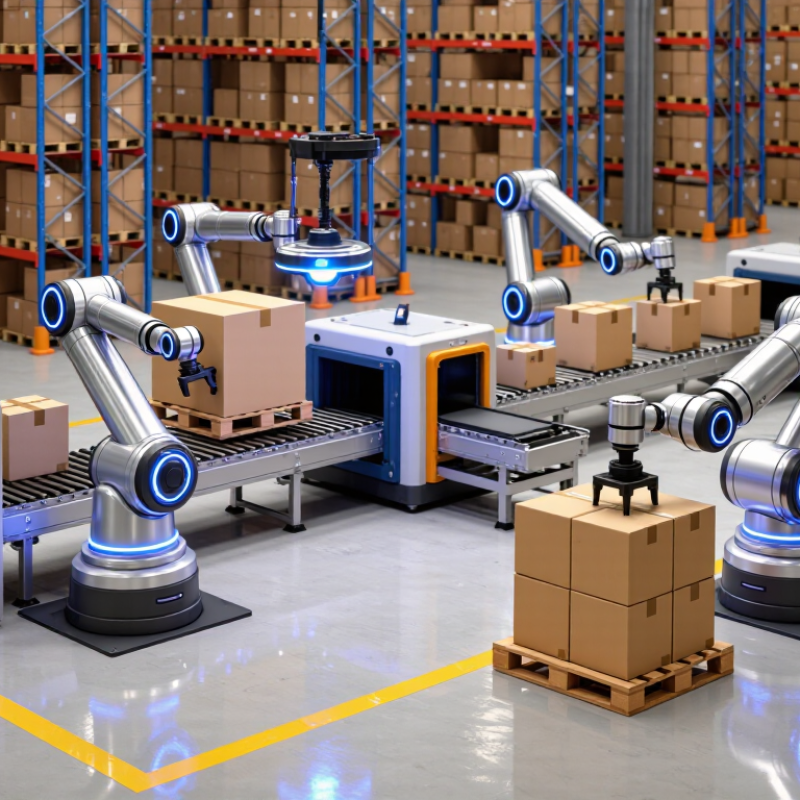
Definition and Role of Loading Robots in Modern Material Handling
Loading robots are automated systems that move goods between transport vehicles, conveyors, pallets, and storage areas. They may use robotic arms, telescopic conveyors, vacuum grippers, or roller platforms. Their main role is to reduce manual lifting, improve loading consistency, and support safer material flow.
In a busy warehouse, a loading robot can place cartons onto a pallet at a steady height and pace. Sensors detect package size, weight, position, and possible obstacles. Control software then adjusts movement in real time. This matters. A stable loading pattern can reduce product damage and improve truck-space utilization. It can also shorten waiting time near loading docks.
From practical project experience, successful deployment depends on more than robot speed. Engineers must examine dock dimensions, floor conditions, package variation, and worker access. Safety scanners, emergency stops, and clear operating zones remain essential. Maintenance teams also need simple access to grippers, sensors, and cables. A design that looks efficient may fail when cartons arrive unevenly. That weakness deserves attention. Global buyers should request load tests, training details, spare-part plans, and documented safety procedures before selecting a manufacturer.
China Top 10 Loading Robot Manufacturers for Global Buyers
Definition and Role of Loading Robots in Modern Material Handling
Loading robots are automated systems designed to pick, transfer, stack, or place goods during warehouse, palletizing, depalletizing, and vehicle-loading operations. The chart shows representative payload-capacity ranges commonly specified for industrial loading-robot applications. Higher payload capacity generally supports heavier cases, bags, layers, and pallet loads, while robot selection also depends on reach, cycle time, accuracy, gripper design, and safety requirements.
Data units: kilograms per robotic handling cycle. Ranges consolidate common published industrial specification levels and exclude the weight of the end-of-arm tooling.
Key Technologies Used in Industrial Loading Robots
When global buyers compare China’s top 10 loading robot manufacturers, technology should guide the decision. Industrial loading robots now combine mechanical strength, machine vision, motion control, and real-time safety systems. The International Federation of Robotics reported 541,302 industrial robot installations worldwide in 2023. Its World Robotics 2024 report also recorded more than 4.28 million robots in operation. These figures show why loading technology must support stable, continuous production.
Machine vision helps robots identify cartons, pallets, and irregular positions. Three-dimensional cameras can measure height differences before the gripper moves. Force sensors then detect contact during insertion, stacking, or palletizing. This reduces crushed packaging and accidental impacts. Servo motors provide accurate positioning, while PLC systems coordinate conveyors, scanners, and emergency stops. The details matter. A fast robot with poor handoff timing still creates bottlenecks.
Artificial intelligence is entering vision inspection and path planning, but it needs clean production data. Digital twins can test reach, cycle time, and collision risks before installation. Safety functions should follow recognized requirements, including ISO 10218 for industrial robot systems. The International Data Corporation has identified automation and AI as major investment priorities in manufacturing, yet adoption is not automatically successful. Dust can weaken camera accuracy. Reflective wrapping can confuse vision systems. Even experienced teams sometimes underestimate maintenance access. Buyers should therefore examine cycle-time evidence, safety validation, spare-part availability, and operator training records, not only brochure specifications.
China Top 10 Loading Robot Manufacturers for Global Buyers - Key Technologies Used in Industrial Loading Robots
Anonymous comparison of major Chinese industrial loading-robot manufacturer profiles and commonly published technical capabilities
| Rank | Manufacturer Profile | Primary Robot Configuration | Typical Payload Range | Typical Reach Range | Typical Repeatability | Key Technologies Used | Typical Loading Applications | Best-Fit Buyer Requirements |
| 1 | Manufacturer Profile A | Six-axis articulated robot | 20–210 kg | 1.7–3.2 m | ±0.03–0.08 mm | Servo motion control 3D vision Collision detection Automatic tool changing | Palletizing, machine tending, carton loading and end-of-line handling | Flexible production lines requiring multiple loading positions |
| 2 | Manufacturer Profile B | Heavy-payload six-axis robot | 100–500 kg | 2.6–3.9 m | ±0.05–0.12 mm | High-torque servo motors Harmonic or RV reducers Dynamic load compensation Safety-rated stop | Steel components, automotive parts, castings and large containers | Heavy industrial loading with long duty cycles |
| 3 | Manufacturer Profile C | Four-axis palletizing robot | 80–300 kg | 2.0–3.2 m | ±0.05–0.10 mm | High-speed interpolation Layer-pattern software Vacuum and clamp grippers Conveyor synchronization | Bags, cartons, cases, bottled products and warehouse pallets | High-throughput repetitive palletizing and depalletizing |
| 4 | Manufacturer Profile D | Collaborative loading robot | 5–30 kg | 0.9–1.7 m | ±0.02–0.05 mm | Force-torque sensing Power and force limiting Hand-guiding No-code programming | Small-part loading, CNC tending, packaging and assembly support | SMEs, short production runs and limited-floor-space facilities |
| 5 | Manufacturer Profile E | SCARA loading robot | 3–20 kg | 0.4–1.0 m | ±0.01–0.03 mm | High-speed pick-and-place Vision-guided alignment Delta or servo conveyors Recipe-based control | Electronic components, trays, cartons, medical disposables and small parts | Fast, accurate loading in compact work cells |
| 6 | Manufacturer Profile F | Cartesian gantry loading system | 50–1,000 kg | 1.5–8.0 m axis travel | ±0.05–0.20 mm | Linear servo axes PLC motion control Multi-axis interpolation Load-cell feedback | Machine loading, sheet-metal handling, pallets and oversized workpieces | Large work envelopes and straight-line loading routes |
| 7 | Manufacturer Profile G | Robotic machine-tending cell | 10–165 kg | 1.4–2.7 m | ±0.03–0.08 mm | CNC interface integration Door and chuck interlocks Part-present sensors MES connectivity | CNC lathes, machining centers, press loading and unloading | Automated machine tending with traceability requirements |
| 8 | Manufacturer Profile H | Mobile palletizing robot | 20–80 kg | 1.6–2.4 m | ±0.05–0.10 mm | AMR navigation LiDAR mapping Battery management Fleet dispatch software | Mixed-SKU palletizing, warehouse replenishment and line-side loading | Facilities needing flexible deployment without fixed conveyors |
| 9 | Manufacturer Profile I | Parallel or delta loading robot | 1–15 kg | 0.6–1.6 m | ±0.01–0.05 mm | Real-time vision Parallel kinematics Vacuum picking Reject tracking | Food, pharmaceuticals, consumer goods and lightweight packaging | Very high cycle rates and hygienic product handling |
| 10 | Manufacturer Profile J | Customized multi-robot loading line | 10–300 kg per robot | 1.2–3.5 m | ±0.03–0.10 mm | Digital twin simulation PLC and robot synchronization Industrial Ethernet Remote diagnostics | Automotive, logistics, building materials and mixed-product loading | Turnkey projects requiring engineering, integration and commissioning |
Technical values are representative ranges commonly specified for industrial loading robots. Actual payload, reach, repeatability, cycle time and safety performance depend on the selected model, end-of-arm tooling, workpiece geometry, installation conditions and applicable regional standards.
How to Evaluate Loading Robot Manufacturers for Global Projects
For global buyers, evaluating loading robot manufacturers requires more than comparing price lists. A reliable supplier should explain payload, reach, cycle time, and container compatibility in measurable terms. Ask for test videos using cartons, sacks, or drums similar to your operation. Generic demonstrations can hide unstable grips, uneven floors, and poor lighting. Request production references from facilities with comparable throughput and climate. Experience matters when a robot works beside conveyors, forklifts, and human operators.
Technical evidence should include load charts, end-effector drawings, safety assessments, and maintenance intervals. Check whether controls support your voltage, language, network standards, and data-security requirements. Confirm who installs the cell, trains operators, and supplies replacement parts overseas. A written response time is more useful than a confident sales promise. Inspect weld quality, cable routing, guarding, and emergency-stop access during a factory visit or live audit. Small details reveal manufacturing discipline.
Do not ignore integration risk. Ask the manufacturer to model pallet patterns, product variation, and peak-season demand before signing. A pilot run with your actual packaging can expose jams that brochures never mention. It may also show that a lower-cost gripper damages soft cartons. That lesson is inconvenient. It is valuable. Compare total ownership costs, including energy, software updates, spare parts, and technician travel. Independent certification helps, but certificates should match the delivered configuration, not a similar model. Keep acceptance criteria specific, measurable, and agreed by both sides.
China’s Top 10 Loading Robot Manufacturers and Their Main Strengths
China’s top 10 loading robot manufacturers stand out through different strengths. One focuses on heavy-payload arms for bags, cartons, and drums. Another specializes in palletizing lines with stable layer patterns. A third develops truck-loading systems that reduce manual handling near dock doors. Vision-guided equipment can identify uneven carton positions. Useful in busy warehouses. Collaborative robots support smaller factories with limited floor space. High-speed models suit beverage and parcel operations. Some manufacturers build robots for dusty, cold, or humid environments. Custom engineering is another major advantage, especially for unusual package sizes. System integrators connect robots with conveyors, scanners, weighing units, and warehouse software. Service-oriented suppliers provide spare parts, remote diagnostics, and local training.
Global buyers should compare more than published payload and cycle-time figures. Factory acceptance tests should measure reach, stopping accuracy, carton stability, and recovery after a fault. Ask for sample data from similar loads. A polished demonstration may not represent a difficult shift. That matters. Experienced buyers should inspect weld quality, cable protection, safety sensors, and software access. They should also confirm installation responsibilities, training hours, and response times. Some manufacturers offer impressive customization but weaker documentation. Others deliver reliable hardware but limited overseas support. This gap deserves attention. A practical shortlist should balance mechanical performance, integration skill, safety compliance, maintenance access, and long-term communication. The best supplier is not always the fastest one. Reliability often appears during the ninth month, not the first demonstration.
International Buying, Compliance, Installation, and After-Sales Considerations
China Top 10 Loading Robot Manufacturers for Global Buyers
International buying starts with verification, not attractive pricing. Request the company’s legal registration, factory address, export history, and technical contact. A supplier should provide clear drawings, cycle-time data, payload limits, and a realistic quotation. Do not guess. Confirm which standards apply in the destination market, such as electrical, machinery, and workplace safety requirements. Ask for test reports, declarations, manuals, and traceable component information before payment.
Compliance documents must match the delivered machine. Check the model number, voltage, frequency, guarding design, and emergency-stop layout. Customs paperwork should include accurate descriptions, packing lists, invoices, and origin details. An independent inspection before shipment can reveal loose cables, damaged sensors, or incomplete accessories. That gap matters. A low-cost offer may exclude installation tools, software licenses, or local taxes.
Installation planning deserves equal attention. Measure the loading area, floor capacity, door width, power supply, network access, and compressed-air quality. Agree on factory acceptance testing, site acceptance testing, operator training, and performance criteria in writing. After-sales support should state response times, spare-part availability, remote diagnostic limits, and warranty exclusions. Keep critical sensors and grippers on site. In practice, even strong projects can suffer from unclear handover documents or delayed translation. Build time for correction. International projects rarely fail from robotics alone; they often fail at the edges between supplier, installer, customs, and operator.