7 Tips for Swiss Turning Titanium Bone Screws
Titanium bone screws look small, yet their machining demands are unforgiving. A thread crest can measure only a few tenths of a millimeter, while surface damage may affect insertion torque, fatigue life, and tissue response. For manufacturers, Swiss turning offers controlled production of these demanding components. Swiss Turning Services For Titanium Bone Screws can support stable concentricity, fine threads, and repeatable dimensions across high-volume medical orders.
The market pressure is real. Grand View Research estimated the global orthopedic implants market at approximately USD 47 billion in 2023 and expects continued growth through 2030. That expansion increases demand for reliable, traceable screw production. FDA guidance on orthopedic devices also emphasizes design controls, material safety, process validation, and documented manufacturing evidence. ISO 5832-3 remains a widely referenced standard for wrought titanium alloy used in surgical implants. Standards do not replace engineering judgment. They structure it.
This guide, “7 Tips for Swiss Turning Titanium Bone Screws,” focuses on practical decisions from cutting-tool selection to coolant control and burr removal. Titanium can generate heat quickly, cling to tooling, and work-harden after unstable cutting. A dull insert may leave a blue-tinted thread flank and measurable burrs near the drive recess. That detail matters. Small defects can become inspection failures or clinical concerns.
The recommendations are based on common precision-machining practice, supplier documentation, and medical-device quality expectations. Still, no process is automatically correct. Chucking methods, alloy condition, screw geometry, and machine capability must be reviewed together. Even experienced teams should challenge their assumptions. Better results often begin with one uncomfortable question: what has not been measured yet?
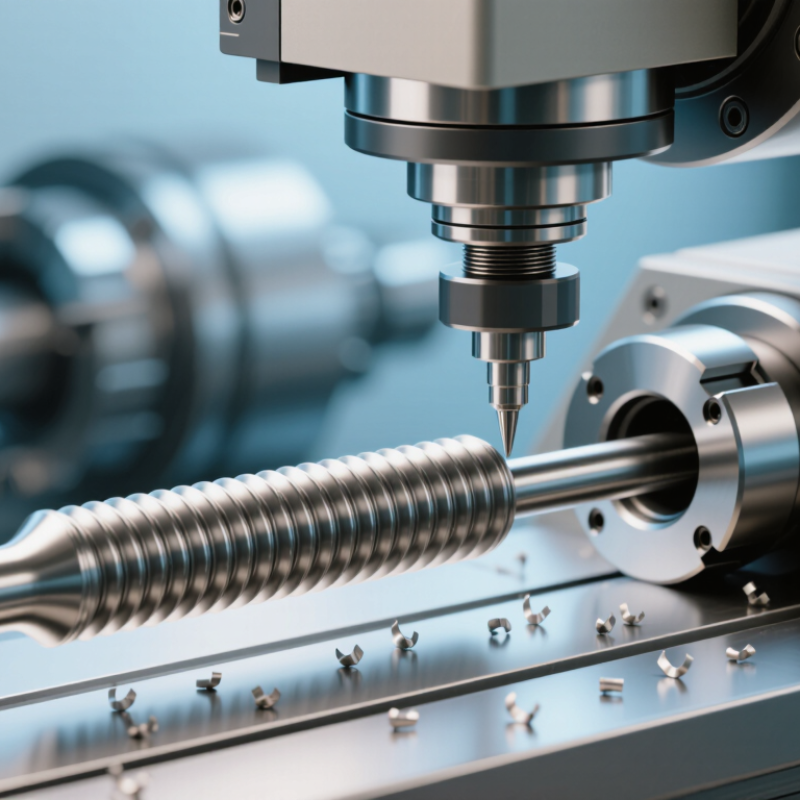
Titanium Properties That Affect Bone Screw Turning
Titanium Properties That Affect Bone Screw Turning
Titanium behaves differently from many stainless steels during Swiss turning. Its low thermal conductivity traps heat near the cutting zone. That heat stays concentrated around the insert and workpiece. Cutting edges can wear quickly when speeds, feeds, or coolant delivery are poorly matched.
Titanium also has strong chemical reactivity at cutting temperatures. A worn tool may encourage built-up material and damage the thread profile. Sharp, positive-rake tooling helps reduce rubbing and cutting pressure. However, excessive edge sharpness can weaken the insert. This balance deserves careful testing. Small changes matter.
The material’s elasticity creates springback after cutting. Internal threads may shift slightly from the expected size, especially with slender parts. Titanium can also work-harden when the tool dwells or follows an unstable path. Keep the tool engaged with a consistent feed. Avoid repeated rubbing passes. Chip control remains critical because long, hot chips can scratch finished surfaces or interrupt automatic production.
A rigid guide bushing supports accuracy near the head and thread. Controlled coolant should reach the actual cutting edge, not only the outside of the part. Conservative trial cuts often reveal more than aggressive settings. Record tool life, burr formation, surface texture, and thread measurements together. One overlooked detail is workholding pressure. Too much pressure can distort a thin screw before inspection. Process validation should use the final alloy, geometry, and sterilization requirements, because laboratory results may not represent production behavior.
Cutting Tools and Parameters for Stable Machining
Swiss turning titanium bone screws demands controlled heat, sharp tools, and disciplined parameter changes. Titanium conducts heat poorly, so excessive speed quickly damages the cutting edge. Use sharp carbide inserts with positive rake geometry and a small nose radius, typically 0.1–0.2 mm. Polished cutting edges can reduce built-up material during fine turning.
Start with a cutting speed of 45–75 m/min, depending on alloy condition and tool coating. For small screw diameters, begin near the lower end. A feed rate of 0.03–0.08 mm per revolution supports stable finishing. Keep finishing depth above the tool’s minimum engagement limit. Very light cuts may rub instead of cutting. That mistake is easy to miss.
Direct high-pressure coolant toward the cutting zone, especially during threading and slotting. A stable guide bushing setting helps prevent vibration along the slender workpiece. Use short tool overhangs and inspect the thread crest under magnification. For threading, reduce speed and maintain consistent infeed rather than forcing one deep pass. I once increased speed to improve productivity, but the surface became blue and rough. That assumption was wrong. Check chip shape, edge wear, burr formation, and part temperature after each trial. Record the results before adjusting another variable. Small changes usually reveal more than aggressive corrections.
Chip Control, Cooling, and Surface Protection
7 Tips for Swiss Turning Titanium Bone Screws
Chip Control, Cooling, and Surface Protection
Titanium rewards control, not aggressive cutting. Use a sharp carbide insert with a positive rake, strong edge support, and a chipbreaker suited to small diameters. Keep the tool overhang short, and support the bar close to the cutting zone. Stable workholding reduces vibration marks on the screw head and threads. One detail is easy to miss. Never allow chips to recut across the finished surface.
ASM Handbook data lists titanium’s thermal conductivity near 6.7 W/m·K at room temperature, far below common steels. Heat therefore remains concentrated near the cutting edge. Apply directed, high-pressure coolant through the tool zone, and keep the flow continuous during thread turning. Reduce heat further with a balanced speed and feed, rather than feed alone. Sharp tools matter more than many operators expect. Replace them before flank wear creates a dull, smeared surface.
Use separate, clean soft jaws for finished parts, and avoid contact with steel chips. Protect threads with non-abrasive trays during transfer. Inspect under magnification for burrs, built-up edge, discoloration, and torn flanks. ISO 10993-18 emphasizes chemical characterization for patient-contact materials, so contamination control deserves documented verification. In practice, cleaning records and tool-life logs often reveal problems earlier than final inspection. My own caution is simple: coolant pressure is not automatically better. Excessive flow can disturb slender parts and worsen chip evacuation. Validate the setup on sacrificial pieces before production.
Inspection Standards for Finished Bone Screws
Inspection Standards for Finished Bone Screws
Finished titanium bone screws demand more than a bright surface. The FDA’s 2023 Medical Device Recalls report identifies manufacturing defects as a recurring device-risk category. Inspection must therefore connect machining evidence with patient safety.
Measure major diameter, thread pitch, length, drive depth, and head height using calibrated gauges. Check the complete thread profile under magnification. One damaged crest can affect insertion torque. Verify the material against ASTM F136 or ISO 5832-3, using certified chemical analysis when required. Inspect burrs, tool marks, discoloration, and embedded particles. These small defects are easy to miss.
Do not trust appearance alone.
Test axial pullout or torsional performance according to the approved product specification. Record torque results, because an acceptable dimension does not guarantee functional strength. Confirm surface cleanliness through validated residue testing. ISO 10993-18 can support chemical characterization, while ISO 10993-5 and ISO 10993-10 address relevant biological evaluation pathways. Packaging inspection also matters. Look for seal damage, particulate contamination, and incorrect labels.
Keep full inspection records.
A practical control plan should link every result to the machine, lot, operator, gauge, and calibration status. ISO 13485 emphasizes traceability and documented production controls. In practice, the weakest step may be data review, not machining. A second-person check can catch transposed measurements or incomplete records. That safeguard feels basic, but it prevents avoidable release errors.