A Marine Washing Machine is built for a difficult environment. It must clean clothes while coping with limited freshwater, unstable power, vibration, and changing sea conditions. Unlike a household washer, it may use seawater-resistant components, compact drum designs, and specialized drainage systems. Space matters. Every centimeter counts.
Marine systems author Nigel Calder offers a useful principle: “A boat’s systems must work together, not in isolation.” This idea explains how a Marine Washing Machine operates onboard. Water enters through a controlled supply line, passes through a filter, and fills the drum. A motor turns the drum through wash and spin cycles. Used water then moves through a secure drain system, often with a pump and anti-siphon protection. Sensors may control water level, temperature, and load balance.
The process sounds simple. It is not always simple at sea. A rough passage can shift clothing inside the drum, causing vibration and stopping the spin cycle. Hard water can leave mineral deposits. Limited electrical capacity may restrict heating performance. Operators must also consider freshwater tanks, greywater arrangements, ventilation, and maintenance access. These details reveal an important limitation: no single design suits every vessel.
This guide examines what a Marine Washing Machine is, how its components work, and why marine installation differs from home use. It also considers practical mistakes, including overloading, poor drainage, and ignoring corrosion. Real-world reliability depends on correct installation and honest maintenance. Sometimes, the smallest overlooked hose causes the biggest problem.
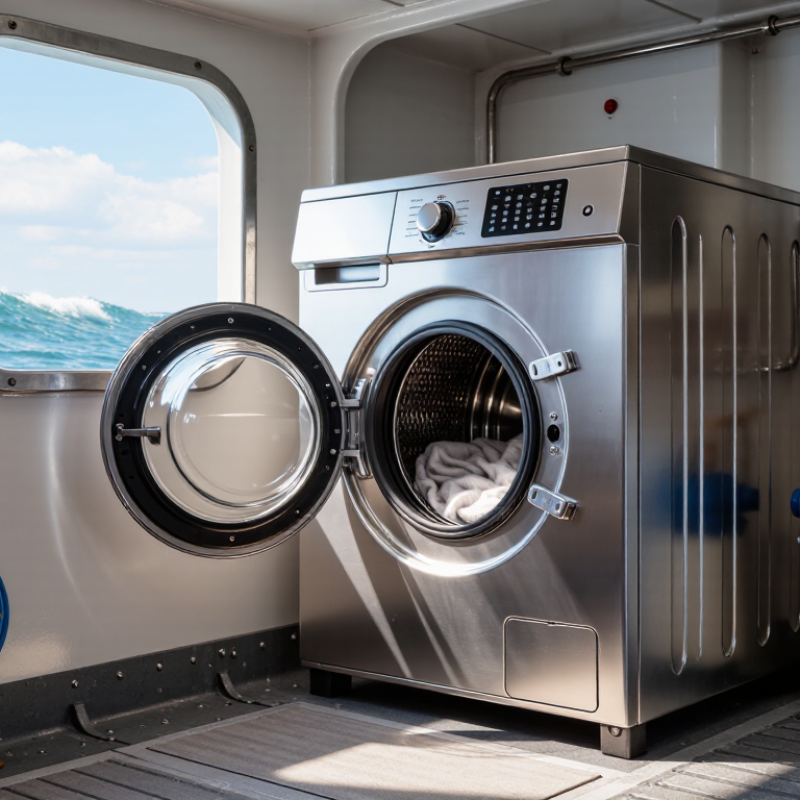
A marine washing machine is a compact laundry appliance designed for ships, yachts, offshore platforms, and research vessels. Its purpose is practical: clean clothing, bedding, towels, and protective workwear during long voyages. Unlike a household model, it must handle limited space, vessel movement, vibration, humidity, and restricted freshwater supplies. The term is not perfectly standardized. Some systems are domestic-sized, while others use separate commercial washers and dryers.
The machine fills with treated freshwater, mixes it with detergent, and rotates a perforated drum. Water then drains through the vessel’s approved wastewater system. A high-speed spin removes much of the moisture before drying. Marine installations often require secure mounting, corrosion-resistant parts, and electrical protection suitable for onboard conditions.
UNCTAD’s Review of Maritime Transport 2023 states that over 80% of global merchandise trade by volume moves by sea. That scale explains why reliable onboard laundry supports crew welfare and operational continuity. Energy use still matters. The Fourth IMO GHG Study 2020 estimated international shipping produced about 2.89% of global anthropogenic greenhouse-gas emissions in 2018.
Tips: Check freshwater pressure, drainage capacity, load limits, and vibration controls before installation. Use low-foam detergent and avoid overloading the drum. A small mistake can create leaks, imbalance, or unnecessary water consumption. Operators should also record cycle times and maintenance issues. Real onboard data may challenge the manufacturer’s ideal figures.

A marine washing machine is designed for shipboard laundry, where space, vibration, salt air, and limited freshwater create daily challenges. Its stainless-steel drum resists corrosion and handles frequent loads. A reinforced frame reduces movement during rough seas. Shock absorbers protect bearings, panels, and nearby piping. The variable-speed motor controls drum rotation, while a sealed drive system limits moisture damage.
The water circuit includes an inlet valve, heating element, circulation pump, drain pump, and lint filter. A programmable control panel manages temperature, spin speed, water level, and cycle time.
Some systems connect to freshwater tanks and greywater lines. This arrangement supports tighter water management onboard.
ENERGY STAR commercial-clothes-washer criteria report around 45% lower water use and 25% lower energy use than standard models. That matters under the IMO 2023 GHG Strategy, which targets net-zero emissions from international shipping around 2050. Efficiency is not only a shore-side concern.
Inspect hose clamps, door seals, filters, and vibration mounts every week. Salt residue can hide behind panels. Keep the drain line short and properly supported. A technician should verify electrical protection and ventilation before commissioning.
In practice, the most efficient machine can still waste water when crews overload it. That mistake is easy to miss. Record cycle data, but question the readings when sensors become unreliable.
A marine washing machine is built for compact laundry rooms, limited water, and constant vessel movement. Its washing cycle begins when the door locks and the drum checks the load balance. Sensors measure water level, temperature, and motor resistance during operation. The control system then selects a suitable sequence for the fabric and load size.
Fresh water enters through a controlled valve, often in smaller amounts than household machines use. Detergent mixes with the water before the drum turns slowly. This movement wets the fabric and loosens salt, sweat, and ordinary stains from work clothing. During the main wash, the drum changes direction repeatedly. That action prevents clothing from forming one heavy, twisted bundle. It also helps the motor work safely when the ship rolls.
Rinsing removes detergent through several short water exchanges. A pump sends used water toward the vessel’s approved wastewater system, not simply anywhere overboard. The final spin accelerates gradually, because sudden imbalance can shake nearby fittings. A level sensor may stop the spin and redistribute the clothes. It is not a perfect process. A badly loaded drum can still vibrate. Small errors matter at sea. Operators should inspect hoses, door seals, filters, and mounting bolts regularly. In practice, shorter cycles may save water, but heavily soiled protective clothing may need another wash. The machine protects resources, yet human judgment remains important.
| Data Dimension | Typical Marine Washing Machine Information | How It Applies at Sea |
|---|---|---|
| Primary purpose | Cleaning clothing, towels, bedding, and other washable textiles in a vessel’s laundry area. | It reduces the need to store large quantities of clean clothing during long voyages. |
| Power supply | Usually supplied by the vessel’s electrical system, commonly using marine-compatible alternating current. | The machine must match the vessel’s voltage, frequency, circuit protection, and available generator capacity. |
| Water source | Fresh water from the ship’s potable-water or technical-water system. | Direct seawater use is generally unsuitable because salt can promote corrosion and leave deposits; seawater normally requires treatment before laundry use. |
| Typical load capacity | Approximately 5–12 kg for compact or crew-laundry units; larger commercial marine installations may use higher capacities. | Capacity is selected according to crew size, voyage duration, laundry demand, and available floor space. |
| Loading arrangement | Front-loading designs are common, while compact top-loading designs may also be used. | The installation must leave enough clearance for loading, servicing, ventilation, and safe movement around the appliance. |
| Vibration control | Uses adjustable feet, rigid mounting, shock-absorbing supports, and a properly balanced drum. | The unit must be secured against vessel motion and high-speed drum imbalance, especially during spinning. |
| Drainage system | A drain pump or gravity drain removes used water through approved laundry wastewater piping. | Drain hoses and connections need secure routing to prevent leaks, backflow, and movement-related disconnection. |
| Water temperature | Cold, warm, or heated cycles are typically available; many everyday loads use temperatures around 20–40°C. | Lower-temperature cycles can reduce energy use, while hotter settings may be selected for heavily soiled or hygienically sensitive items when fabric care permits. |
| Main washing action | The drum rotates and repeatedly lifts, drops, and tumbles the textiles through detergent solution. | Mechanical action combines with water and detergent to loosen soil from the fabric. |
| Typical washing cycle sequence | Load sensing or filling → prewash if selected → main wash → draining → one or more rinses → final drain → spin. | The controller coordinates water valves, drum movement, pump operation, heating, and spin speed throughout the program. |
| Rinsing stage | Fresh water passes through the textiles to remove detergent and suspended soil; several rinses may be used. | Effective rinsing is important because residual detergent can irritate skin and leave deposits in the machine. |
| Spin extraction | The drum rotates rapidly to force water out through centrifugal action; compact units commonly offer several hundred to over 1,000 revolutions per minute, depending on design. | A higher spin speed can shorten drying time but increases the need for proper leveling, securing, and load balance. |
| Cycle duration | Approximately 30–180 minutes, depending on the selected program, load size, water temperature, and rinse settings. | Longer cycles may provide more cleaning action or lower energy consumption, while quick cycles support urgent laundry needs. |
| Water consumption | Roughly 40–100+ litres per complete load for many household-sized machines, depending on design and program. | Actual use depends on load size, water level, rinse count, machine efficiency, and whether water is reused or treated onboard. |
| Detergent requirements | Low-sudsing, biodegradable detergent suitable for the vessel’s wastewater-treatment rules is generally preferred. | Excess detergent can increase foaming, water use, rinse time, and the treatment burden on the ship’s wastewater system. |
| Safety features | Door-lock interlock, overload protection, leak protection, thermal protection, imbalance detection, and automatic shutdown may be included. | These features help protect crew members, electrical systems, plumbing, and the machine during vessel movement or abnormal operation. |
| Installation environment | A dry, ventilated, level location with suitable drainage, electrical protection, and access for maintenance. | The machine should be protected from direct seawater spray, excessive humidity, heat, and unauthorized movement. |
| Key maintenance tasks | Inspect hoses and seals, clean the pump filter, remove detergent residue, check mounting points, keep the door seal dry, and inspect electrical connections. | Routine maintenance helps prevent leaks, odours, vibration damage, blockages, corrosion, and unplanned laundry-service interruptions. |
Note: Figures are typical operating ranges for marine or compact commercial laundry installations. Exact requirements vary with vessel type, machine design, onboard utilities, load size, and applicable maritime regulations.
A marine washing machine is a compact appliance designed for limited freshwater, unstable power, and vessel movement. Its drum rotates during wash and spin cycles, while an onboard pump removes greywater through a hose. Unlike a household unit, it usually has stronger restraints, corrosion-resistant fittings, and vibration control. Some models support cold-water-only operation, which reduces plumbing complexity.
Installation demands more than finding an empty cabinet. NMMA’s 2023 Recreational Boating Statistical Abstract recorded about 11.6 million registered recreational boats in the United States, with most measuring below 26 feet. Space is tight. The machine needs a level, reinforced base, service clearance, and ventilation around its motor and electronics. Locking brackets are essential because spin cycles can shift equipment on rough water. A dedicated circuit, correctly sized breaker, shore-power protection, and proper grounding should follow ABYC E-11 principles. An inverter may work, but its continuous output must cover the washer’s starting load.
Drain design deserves careful attention. Route wastewater to an approved greywater system or holding tank, according to the vessel’s operating area. Avoid low loops that trap water and create odors. The U.S. Coast Guard reported 4,012 recreational boating accidents in 2023, reminding installers that small electrical or plumbing errors can become safety issues. A practical weakness remains: compact machines often sacrifice load capacity for stability. That trade-off is easy to underestimate. Test the unit during dockside operation, then inspect hoses, fasteners, and leakage after the first voyage.
A marine washing machine is built for compact, moving environments. Its drum handles clothing while the vessel’s water system supplies and removes water.
During operation, keep the machine level and avoid overloading the drum. Uneven loads can increase vibration, especially when the vessel is underway.
Secure the door firmly, select a suitable cycle, and confirm that the discharge hose remains properly supported. A loose hose can flood a confined laundry space within minutes.
Maintenance should follow the equipment manual and the vessel’s inspection schedule.
Clean the lint filter regularly, wipe salt residue from metal surfaces, and check hoses for cracks or swelling. Inspect electrical connections for moisture, heat marks, or corrosion.
Freshwater filters may also need cleaning when flow becomes weak. Leave the door slightly open after use, if the vessel’s conditions allow it.
This reduces trapped moisture and unpleasant odors.
Safety depends on small habits. Disconnect power before cleaning, opening service panels, or clearing a blocked pump. Never reach into a moving drum.
Keep the floor dry and maintain ventilation around the machine. A child-lock feature is useful, but it is not a substitute for supervision.
In practical service checks, the forgotten hose clamp is often the real problem. I have also seen maintenance delayed because the machine still appeared to work.
That judgment can be misleading. Record unusual noise, movement, or draining problems, and have a qualified marine technician investigate them before the next voyage.