How to Find the Best Heat Lamination Machine Price?

Finding the best heat lamination machine price is not simply a matter of choosing the lowest quotation. A machine priced at $2,000 may appear attractive, yet frequent film jams, slow warm-up times, and expensive replacement rollers can quickly increase ownership costs. Buyers should compare output speed, maximum lamination width, temperature stability, power consumption, warranty coverage, and local technical support.

Packaging equipment consultant David Zwang offers a useful principle: “The lowest purchase price rarely represents the lowest operating cost.” This idea deserves careful attention. A machine running eight hours daily faces different demands from one used for occasional office projects. Ask suppliers for realistic production samples, service response times, spare-part prices, and written warranty terms. Request the exact model configuration, because a quoted heat lamination machine price may exclude stands, feeders, installation, or shipping.

Small details count. Measure your workspace. Check whether the machine reaches the required temperature consistently. Examine finished samples under bright light, especially around edges and overlapping areas. A cheaper unit may produce acceptable results at first, but uneven pressure can become costly later.

There is no perfect comparison. Some suppliers publish incomplete prices, while others bundle useful accessories. That can confuse even experienced buyers. A reliable decision therefore combines purchase cost, operating risk, expected workload, and after-sales support. This guide explains how to compare those factors clearly, identify misleading quotations, and choose equipment that fits actual production needs rather than an attractive number on a sales sheet.
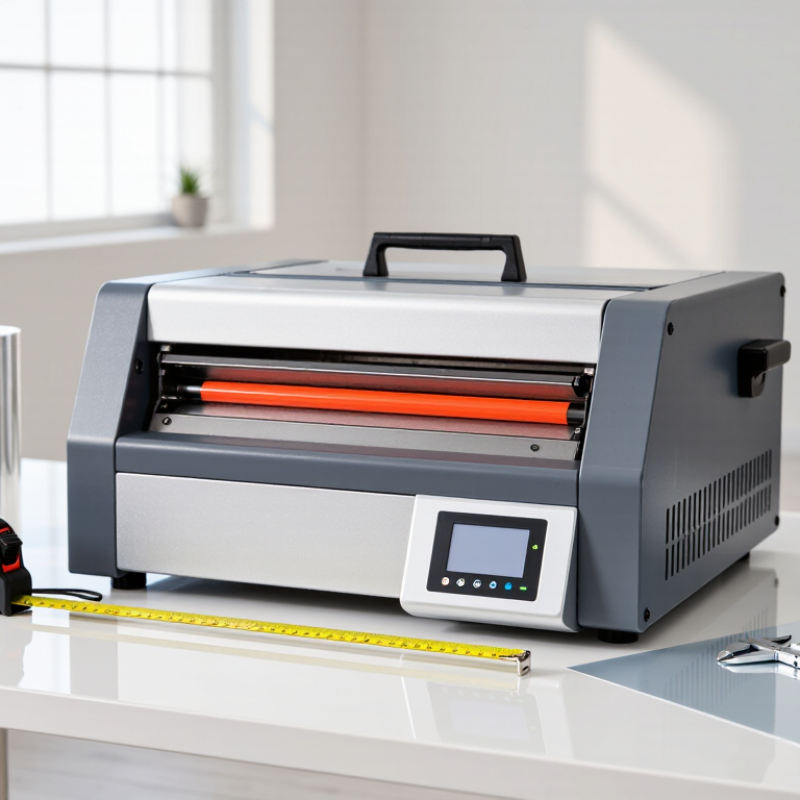
How to Find the Best Heat Lamination Machine Price?

Define Lamination Needs by Film Thickness, Width, and 0.5–30 m/min Speed

Finding the best heat lamination machine price starts with film thickness, working width, and line speed. A machine handling 25-micron film may struggle with 250-micron board. Ask for tested samples, not only catalogue figures. The stated 0.5–30 m/min range also needs careful interpretation. Maximum speed often applies to thin film, simple graphics, and stable feeding conditions.

According to Smithers’ 2024 report, The Future of Printed Packaging to 2029, packaging production is moving toward shorter runs and greater version variety. That trend makes adjustable speed valuable. At 0.5 m/min, an operator can reduce wrinkles on delicate media. At 30 m/min, higher output becomes possible, but only with suitable heating power, roller pressure, and cooling control. Width matters too. A 650 mm machine may be economical for small sheets, while a 1,600 mm model can reduce manual joining on wide rolls.

Compare the complete operating cost, not just the purchase quote. Check heater zones, roller replacement, electricity use, installation, and operator training. Smithers also identifies finishing flexibility as important for changing print applications. A machine with narrow film limits may become expensive later. I would not assume the fastest model is the best value. In real production, frequent stops can erase its advertised advantage. Request speed tests across your actual film thicknesses, widths, and adhesive types. Leave room for mistakes. Trial results are often more useful than a polished specification sheet.


Compare Machine Prices by Heating Method, Roller Width, and Temperature Range

How to Find the Best Heat Lamination Machine Price?

The lowest machine price is rarely the best value. Compare the heating method before checking the final quote. Hot-roll machines usually offer steady heat for frequent work, while heated-plate models may cost less for smaller volumes. Cold-lamination units avoid heating, but they may not suit heat-activated films. In my experience, uneven heating creates bubbles, wasted film, and costly rework. Ask whether the machine has independent temperature control and stable heat recovery.

Roller width directly affects productivity and price. A narrow 320 mm roller can handle labels, menus, and small documents with less power consumption. Wider 650 mm or 1,600 mm rollers support posters, signs, and larger sheets, but they require more space and stronger motors. Measure your usual material first. Buying extra width sounds sensible, yet unused capacity can become an expensive mistake. Check roller pressure adjustment, too. Thin prints may wrinkle when pressure control is poor.

Temperature range deserves careful attention. A machine operating from 60°C to 140°C may suit common thermal films, while specialty films can require tighter control or higher settings. Digital displays help, but real accuracy matters more than impressive numbers. Request a temperature test during evaluation. Record the reading at both roller edges and the center. Small differences can affect gloss and adhesion. I once focused too much on the purchase price and overlooked calibration service. That decision looked efficient, but it was not. Compare warranty coverage, replacement rollers, energy use, and operator training before judging the true heat lamination machine price.

Evaluate Output Quality Using ASTM D1003 Haze and ISO 527 Strength Data

A low heat lamination machine price can hide expensive quality problems. I compare haze and tensile data before comparing purchase prices. ASTM D1003 measures light scattering in transparent laminated materials. High haze may indicate uneven heating, trapped air, poor pressure, or incompatible film layers. Ask for test results from actual production samples, not only laboratory film.

Request the haze percentage, specimen thickness, conditioning time, and test temperature. A small change in film thickness can affect the result. Clear packaging may need very low haze, while technical sheets may allow more variation. Inspect samples under angled light. Cloudiness is often easier to see than a spreadsheet reveals. Test several pieces from different production runs.

ISO 527 data helps evaluate tensile strength and elongation after lamination. Compare machine direction and cross direction results when relevant. A strong-looking sheet can still fail after bending or pulling. Check the test speed, specimen shape, conditioning, and failure mode. My first comparison used different film batches, so the strength results were unreliable. That mistake cost time. Repeat testing with identical materials and settings. Include electricity use, rejected sheets, maintenance, and operator time in the real machine cost. A cheaper machine is not cheaper when unstable temperature creates visible defects.

How to Find the Best Heat Lamination Machine Price? — Evaluate Output Quality Using ASTM D1003 Haze and ISO 527 Strength Data

Representative comparison of heat lamination machine configurations. Lower haze indicates better optical clarity; higher tensile strength indicates stronger laminated film under the stated test conditions.
Machine Configuration Usable Width Operating Speed Temperature Range Installed Power Indicative Price Range ASTM D1003 Haze ISO 527-3 Tensile Strength Quality–Price Interpretation
Entry-Level Heated Roll Laminator 650 mm 3–8 m/min 60–140 °C 4.5 kW US$4,800–7,500 4.8% haze 38.6 MPa Lowest acquisition cost; suitable for short runs and general-purpose protective laminates.
Single-Sided Thermal Film Laminator 1,050 mm 5–12 m/min 60–160 °C 7.5 kW US$8,500–13,000 3.6% haze 41.8 MPa Balanced price and clarity for packaging films, labels, and printed substrates.
Double-Heating-Zone Roll Laminator 1,300 mm 8–18 m/min 60–180 °C 11 kW US$14,000–21,000 2.8% haze 44.7 MPa Improved temperature uniformity and bonding consistency at medium production volumes.
Precision Nip-Roll Laminator with Automatic Tension Control 1,600 mm 10–25 m/min 50–190 °C 15 kW US$22,000–32,000 2.1% haze 47.2 MPa Strong quality-to-cost performance for continuous production and lower reject rates.
High-Uniformity Multi-Zone Laminator 1,800 mm 15–35 m/min 50–200 °C 22 kW US$34,000–48,000 1.6% haze 49.1 MPa High optical quality and bonding strength for demanding flexible-film applications.
Industrial Wide-Web Laminator with Closed-Loop Control 2,200 mm 20–45 m/min 50–210 °C 30 kW US$52,000–78,000 1.2% haze 51.4 MPa Highest throughput and repeatability; justified when quality loss and downtime are costly.
Test basis: Values are representative benchmark figures for a consistent 100 μm PET / 60 μm adhesive / 100 μm PE laminated-film construction after conditioning at 23 ± 2 °C and 50 ± 5% relative humidity. Haze is reported according to ASTM D1003 using a calibrated haze meter. Tensile strength is reported according to ISO 527-3 for film specimens, with results expressed in MPa. Actual results vary with film structure, adhesive, nip pressure, temperature uniformity, line speed, and test laboratory.

Calculate Total Cost of Ownership from Energy, Film Waste, and Maintenance

How to Find the Best Heat Lamination Machine Price?

A low purchase price can hide expensive daily losses. Calculate total cost of ownership before comparing quotations. Record machine wattage, operating hours, electricity rate, film width, and output speed. The U.S. Energy Information Administration’s Electric Power Monthly shows industrial electricity near 9 cents per kilowatt-hour in recent U.S. data. A 12 kW laminator running 2,000 hours annually therefore uses about 24,000 kWh, or roughly $2,160 in electricity.

Film waste often costs more than expected. Measure start-up waste, edge trim, roll changes, and rejected packs separately. If one kilogram of film costs $3, a five percent waste rate on 40,000 kilograms creates a $6,000 annual loss. The U.S. Environmental Protection Agency’s Facts and Figures report identifies packaging as an 82.2-million-ton waste stream, reminding buyers that “small” scrap can become a serious operational burden. The report does not describe every lamination line, so this comparison needs factory measurements.

Maintenance also belongs in the spreadsheet. Include heaters, rollers, sensors, cleaning labor, spare parts, and production downtime. PMMI’s State of the Industry reporting repeatedly highlights labor and equipment reliability as manufacturing concerns. My first estimate ignored ten minutes of cleaning per shift. That mistake changed the annual cost noticeably. Ask for service intervals, replacement prices, and realistic uptime records. A cheaper machine may still win, but only after energy, film waste, maintenance, and missed production are priced together.

Verify Supplier Value Through Warranty Terms, Certifications, and ROI Estimates

How to Find the Best Heat Lamination Machine Price?

Verify Supplier Value Through Warranty Terms, Certifications, and ROI Estimates

Finding the best heat lamination machine price requires more than comparing online quotations. A low purchase price can hide costly service gaps. During supplier reviews, I ask for the full warranty document, not a sales promise. Check coverage for heating elements, rollers, control boards, and labor. Confirm the warranty period, response time, transport responsibilities, and exclusions. “Parts only” is not equal to full support. Ask what happens when production stops on a Friday.

Certifications add value only when they are relevant and verifiable. Request certificate numbers, issuing bodies, product models, and expiration dates. Check whether the certificate covers the complete machine, not one internal component. Electrical safety and electromagnetic compatibility requirements may differ by destination market. A supplier should explain those differences clearly. Vague documents deserve caution.

I would also request installation records, operator training details, and maintenance schedules. These practical details reveal supplier competence better than polished brochures.

Use a written ROI estimate before accepting the quoted price. Include hourly output, film consumption, energy use, labor, maintenance, financing, and expected downtime. Compare the estimate with your actual monthly workload. Then test a conservative scenario. The optimistic spreadsheet is often the least reliable witness. A three-year payback may become five years after delays, waste, or replacement parts. Ask for assumptions in writing and challenge each one. I once treated utilization as constant; that was unrealistic. Seasonal demand changed the result. Leave room for uncertainty, because a machine should earn trust through evidence, not confidence.

Wordpress Social Share Plugin powered by Ultimatelysocial
Facebook
X (Twitter)
YouTube
LinkedIn
Share

Purchase Product Request

Request Pricing