30+ Years of Experience in PCB Design and Manufacturing


Buying Carbon Graphite Rods requires more than comparing diameter and price. The correct rod must match the furnace, electrical circuit, machining process, and expected service life. A rod used near 500°C faces different demands from one exposed to 2,000°C. Grade, density, purity, grain size, porosity, and oxidation resistance can change performance significantly.
Carbon materials researcher Dr. Bor Jang has expressed a practical principle: “Structure controls performance.” This idea matters when examining a supplier’s technical sheet. Ask whether the rod is extruded, molded, or isostatically pressed. Check dimensional tolerance, electrical resistivity, bulk density, and ash content. A clean, square-cut end should not show deep cracks, loose particles, or unusual discoloration. Small details matter.
Do not treat the cheapest quotation as the best decision. A low-cost rod may wear quickly, consume more power, or fail under thermal shock. Request a batch certificate, test data, and clear packaging details. Confirm the actual length, diameter, and storage conditions. Moisture and careless handling can damage exposed graphite surfaces. Also ask how the supplier manages oxidation during use, because graphite reacts with air at elevated temperatures.
This guide presents ten practical tips for evaluating Carbon Graphite Rods. It also admits an uncomfortable truth: specifications do not predict every result. Installation, atmosphere, heating rate, and operator habits can alter performance. When uncertain, test a small batch first. That modest step may prevent a costly replacement later.
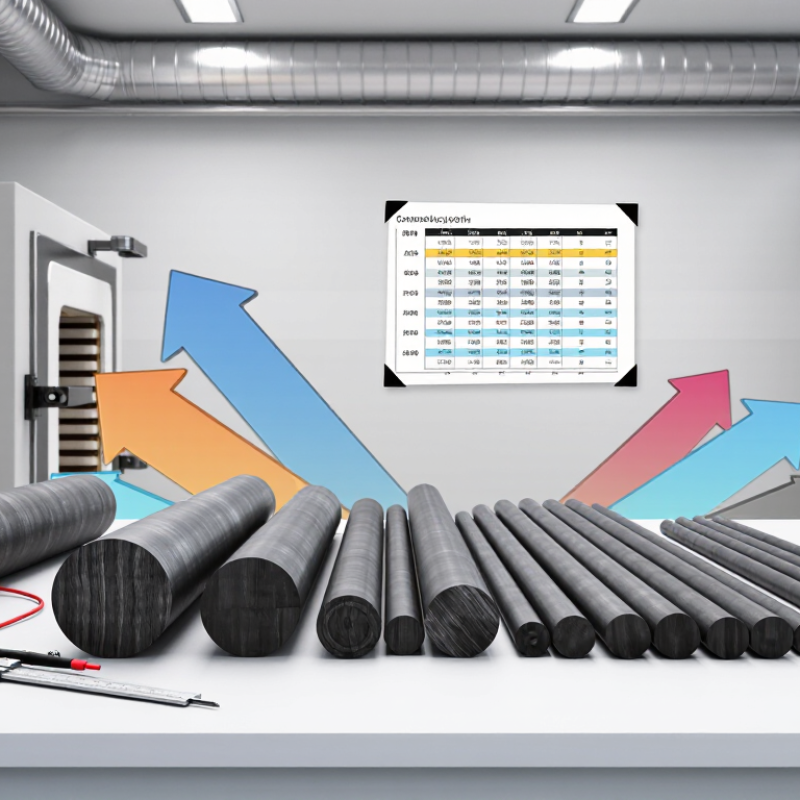
Carbon graphite rods are not interchangeable, even when their dimensions look identical. Extruded rods usually offer consistent shapes and practical electrical conductivity. They suit furnace supports, heating elements, laboratory electrodes, and general machining. Molded rods are often denser and stronger across larger sizes. They can perform well where mechanical stability matters. Isostatic graphite provides more uniform structure and properties in different directions. It is useful for demanding thermal, electrical, and precision applications.
Grain size also affects performance. Fine-grain graphite can produce smoother machined surfaces and better dimensional control. Coarse-grain material may cost less but can show a rougher texture. Impregnated rods resist gas or liquid penetration more effectively. However, treatment can change machinability and electrical behavior. Check density, ash content, resistivity, and maximum service temperature before buying. A supplier should provide measurable specifications, not vague claims.
Application conditions determine the right choice. A rod inside an oxidizing furnace needs protection because graphite reacts with oxygen at elevated temperatures. An electrode requires suitable conductivity, diameter tolerance, and reliable end machining. For chemical use, confirm compatibility with the process fluid. Inspect rods for chipped ends, deep cracks, and uneven surfaces. Small defects can become failures during heating. I have seen buyers focus only on price and diameter. That approach often misses grain structure and purity. No single rod type fits every setup. Test a small sample when the application is critical.
| No. | Buying Tip | Rod Type or Grade | Typical Technical Data | Common Applications | Selection Considerations |
|---|---|---|---|---|---|
| 1 | Define the operating purpose first | General-purpose molded or extruded graphite rod | Bulk density commonly about 1.65–1.85 g/cm³; electrical resistivity often about 8–20 μΩ·m, depending on grade and orientation. | Laboratory fixtures, furnace supports, electrical contacts, machining blanks, and general thermal applications. | Confirm whether the rod will carry current, support a load, contact molten material, or operate in a vacuum or inert atmosphere. |
| 2 | Choose the manufacturing process carefully | Extruded, molded, or vibration-molded graphite | Extruded rods usually have directional properties; molded grades can provide more uniform cross-sections. Grain sizes commonly range from fine powder grades to several millimeters. | Electrodes, heating elements, structural supports, crucible components, and machined parts. | Use extruded material when a continuous rod profile is economical; select molded or fine-grain material when dimensional stability and machinability are more important. |
| 3 | Match purity to contamination limits | Standard, high-purity, or ultra-high-purity graphite | Commercial grades may contain ash in the tenths-of-a-percent range, while high-purity grades can be specified below 0.1% ash and, in some cases, below 0.01% after purification. | Semiconductor processing, vacuum furnaces, analytical equipment, high-temperature crystal growth, and chemical processing. | Request the ash measurement method and impurity list. High purity is useful only when contamination control justifies the additional cost. |
| 4 | Check temperature and atmosphere limits | Industrial graphite for inert, vacuum, or reducing atmospheres | Graphite can remain solid above 2,500°C in suitable inert or vacuum conditions, but it oxidizes in air; significant oxidation can begin at approximately 400–600°C depending on grade and exposure. | Vacuum furnaces, inert-gas heat treatment, high-temperature fixtures, and thermal insulation components. | Do not use unprotected graphite in air at elevated temperature. Consider a coating, shielding gas, or another material when oxygen exposure is unavoidable. |
| 5 | Compare grain size and surface finish | Fine-grain graphite rod | Fine-grain grades generally offer smoother machined surfaces, lower permeability, and improved detail reproduction compared with coarse-grain grades. | Precision electrodes, EDM tooling, semiconductor fixtures, laboratory parts, and close-tolerance components. | Choose fine grain for small diameters, sharp features, tight tolerances, or improved surface quality. Coarser grades may be adequate for large structural parts. |
| 6 | Verify mechanical strength and density | High-density, high-strength graphite rod | Typical room-temperature flexural strength may range from approximately 20–80 MPa, with higher values available in specialized grades; properties decrease with temperature and oxidation. | Mechanical supports, furnace fixtures, electrodes, lifting components, and rotating or sliding parts. | Review flexural strength, compressive strength, modulus, and allowable stress rather than relying only on density. Graphite is brittle and should not be exposed to impact or bending overload. |
| 7 | Evaluate thermal shock resistance | Low-CTE graphite with good thermal conductivity | Thermal expansion is commonly around 2–8 × 10⁻⁶/K, while thermal conductivity may range from roughly 50–170 W/m·K depending on grade and direction. | Rapid-heating furnace fixtures, thermal shields, crucibles, heat spreaders, and high-temperature tooling. | Lower thermal expansion and higher thermal conductivity generally improve resistance to thermal gradients. Always consider grain direction in anisotropic grades. |
| 8 | Specify electrical performance | Electrode-grade or electrically conductive graphite | Electrical resistivity commonly falls between about 5 and 20 μΩ·m; resistance increases with length and decreases with cross-sectional area. | Electrolysis electrodes, resistance-heating components, arc-furnace parts, electrical contacts, and EDM electrodes. | Calculate voltage drop and heat generation using the actual rod dimensions. Ask for resistivity in the required direction when the material is anisotropic. |
| 9 | Consider impregnation or coating | Resin-impregnated, metal-impregnated, or coated graphite | Impregnation can reduce open porosity and fluid permeability; coatings can improve oxidation resistance or chemical compatibility, but may change dimensions and thermal behavior. | Mechanical seals, pump components, chemical-processing parts, furnace fixtures, and applications involving liquids or corrosive vapors. | Check coating temperature limits, adhesion, compatibility with the process fluid, and whether machining after treatment is permitted. |
| 10 | Confirm dimensions, tolerances, and packaging | Precision-cut or custom-machined graphite rod | Specify diameter, length, straightness, concentricity, end condition, surface roughness, and allowable dimensional tolerance. Graphite dust and edge chipping require careful handling. | Replacement shafts, laboratory electrodes, custom furnace parts, wear components, and precision assemblies. | Provide a technical drawing when fit is critical. Request protective packaging, dry storage, and clean handling to prevent chips, moisture uptake, and contamination. |
Technical note: Values shown are typical industry ranges for carbon graphite materials, not universal specifications. Actual performance depends on grade, grain structure, forming method, impregnation, orientation, dimensions, atmosphere, temperature, and test method.