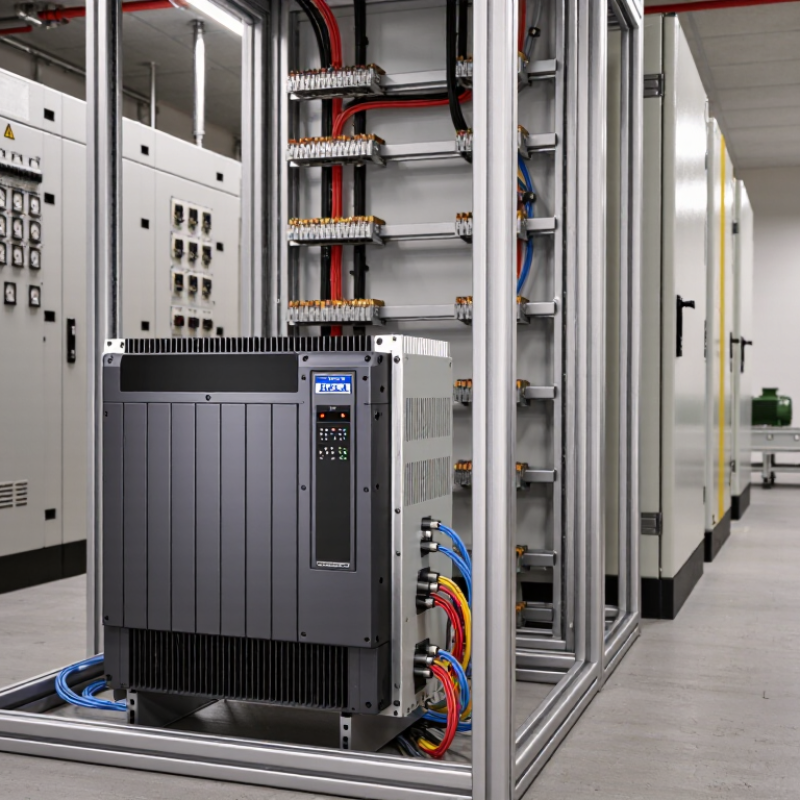
How to Choose the Right Delta Frequency Drive in 2026?

Choosing the right Delta Frequency Drive in 2026 requires more than comparing prices or output power. The correct model must match the motor, load profile, installation environment, and control system. A conveyor, pump, compressor, and elevator demand different drive characteristics. Their acceleration, braking, and overload requirements are rarely identical.

Delta Electronics founder Bruce Cheng framed the company’s mission clearly: “To provide innovative, clean and energy-efficient solutions for a better tomorrow.” That principle remains useful when evaluating a Delta Frequency Drive. Efficiency matters, but it should not replace reliability, protection, or serviceability. A drive that saves energy yet fails in a dusty workshop is not a successful choice. Not even close.

This guide examines practical selection factors for 2026 applications. These include motor voltage, rated current, overload capacity, speed range, braking needs, communication protocols, and enclosure protection. It also considers harmonic concerns, cabinet temperature, installation space, and maintenance access. A pump may benefit from sleep functions and sensorless control. A high-inertia machine may require braking resistance and stronger acceleration management. Small details become expensive problems later.

Real installation experience also teaches an uncomfortable lesson. The most advanced drive is not always the best drive. Engineers can over-specify equipment, while purchasers can under-specify it. Both mistakes increase risk. Verify the motor nameplate, measure the actual load, and review the manufacturer’s technical documentation. Local standards and qualified commissioning support should guide the final decision. Performance claims deserve evidence, not enthusiasm.

How to Choose the Right Delta Frequency Drive in 2026?

Define Load Torque, 50/60 Hz Speed, and 150%/60 s Overload Requirements

How to Choose the Right Delta Frequency Drive in 2026?

Choosing a frequency drive starts with the load torque, not the motor nameplate power. Measure the torque needed during acceleration, steady operation, and sudden changes. A conveyor carrying wet material may need much more starting torque than its running torque suggests. Record the shaft speed and process load at several operating points.

Check whether the motor must run at 50 Hz, 60 Hz, or both. Frequency sets the motor’s base speed, while pole count and slip affect the actual shaft speed. For example, a four-pole motor runs near 1,500 rpm at 50 Hz and 1,800 rpm at 60 Hz, before slip. Do not assume the displayed frequency equals mechanical speed. That mistake can cause poor production results.

Overload capacity needs equal attention. A requirement of 150% current for 60 seconds may suit crushers, mixers, or loaded conveyors, but only if the drive’s rating supports that duty. Compare the overload specification at the required ambient temperature and switching frequency. Cable length, braking, enclosure cooling, and low-speed ventilation also affect selection. A drive that works well in a clean test room may struggle inside a dusty cabinet. I have seen sizing decisions based only on kilowatts; they looked efficient, but acceleration failed. Recheck real torque data before approval. Some assumptions will be wrong.

Match Delta VFD Voltage, Phase, Motor kW, and Current Ratings

How to Choose the Right Delta Frequency Drive in 2026?

Selecting a frequency drive starts with matching its voltage and phase to the power supply. A 400 V three-phase drive cannot replace a 230 V single-phase model without proper system review. Check the motor nameplate, not an old purchase order. Confirm voltage, frequency, rated current, and motor kW. The kW rating helps, but current is often the decisive value. A motor may draw more current during heavy starting or constant-torque operation. I always compare the drive’s continuous output current with the motor’s rated current. A small margin is useful, but oversized equipment can reduce control accuracy and increase cost.

Tips: Record the supply voltage at the panel. Check phase balance. Leave space for cooling. Review the overload rating. Match the drive to the application, not only the motor size.

Pump and fan applications usually need different settings from conveyors, mixers, or crushers. Variable-torque loads may allow a smaller drive, while constant-torque loads require stronger overload capacity. Consider ambient temperature, installation altitude, cable length, braking needs, and enclosure protection. These details are easy to overlook. They often explain unexpected trips. In 2026, built-in monitoring and communication features can improve maintenance, but they do not correct incorrect sizing. I still recheck every selection against the motor’s actual nameplate and measured operating current. Paper calculations can miss real conditions. A short commissioning test may reveal the mistake early.

Compare IEC 61800-9-2 IES Efficiency Classes and Drive Losses

How to Choose the Right Delta Frequency Drive in 2026?

IEC 61800-9-2 evaluates the complete power drive system, not the inverter alone. Its IES classes range from IES0 to IES2. IES2 represents the highest efficiency category under the standard’s defined operating points.

This matters because drive losses change with speed, torque, switching frequency, and cooling demand. A drive rated at 22 kW may lose very differently at 30% load. Check the loss values in watts.

The International Energy Agency reports that electric motor systems consume roughly half of global electricity. Small efficiency improvements can therefore produce meaningful savings across continuous-duty equipment. The European Commission also identifies motor systems as a major industrial energy-saving opportunity.

Compare annual kilowatt-hours, not only the IES label. Use measured operating data where possible. A spreadsheet estimate is useful, but imperfect. Real conveyors rarely follow a neat laboratory profile.

Tips: Request IEC 61800-9-2 loss data at your actual load points. Include standby losses, cooling fans, filters, and braking units. Then calculate yearly energy cost using real operating hours. Review thermal performance inside the cabinet, especially at low speed. A cooler drive may reduce maintenance, yet the lowest purchase price can still hide higher lifetime losses. Check the technical file and test conditions before approving the selection.

Verify IEC 61800-5-2 STO, EMC Compliance, IP Ratings, and Harmonics

How to Choose the Right Delta Frequency Drive in 2026?

Selecting a frequency drive requires more than matching motor voltage and power. Verify IEC 61800-5-2 compliance for the Safe Torque Off function. STO should prevent torque production through a properly documented safety circuit. Check the required safety integrity level, response time, diagnostics, and independent certification. Do not rely only on a product label. Confirm the installation manual, declaration, and validation procedure with a qualified engineer.

EMC performance deserves equal attention. Review IEC 61800-3 categories, cable length limits, shielding methods, and grounding instructions. A drive may pass laboratory tests but create interference in a crowded control cabinet. IP ratings also need practical interpretation. IP55 can resist dust and water jets, but it does not replace correct enclosure placement. Heat, condensation, oil mist, and washdown frequency matter. The highest rating is not always the best choice.

Tips: Measure supply impedance and expected load changes before selecting harmonic controls. Check total harmonic distortion at the point of connection. Line reactors, passive filters, or active filters may be necessary. Leave space for airflow and maintenance access. During commissioning, record motor current, cabinet temperature, EMC symptoms, and fault history. One detail is easy to miss: harmonic measurements can change significantly at partial load. Recheck them under real operating conditions. This step is often skipped, and the decision may need revision.

Choose Control Modes, Communication Protocols, and 2026 Lifecycle Value

Choosing the right frequency drive in 2026 requires more than matching motor power. Control mode affects stability, torque, and energy use. V/f control suits simple pumps and fans. Sensorless vector control handles changing loads better. Closed-loop vector control fits lifting, winding, and precise speed applications.

The U.S. Department of Energy’s Motor Systems Market Assessment reports that motor-driven equipment consumes about 70% of industrial electricity. Small efficiency gains can therefore produce meaningful savings. Communication also affects lifecycle value. Modbus RTU remains practical for basic systems, while Ethernet-based protocols support faster diagnostics and plant-wide data. Confirm compatibility with the existing PLC, safety network, and maintenance tools. IEC 61800 standards provide useful guidance for drive performance and functional safety.

Tips: Compare total lifecycle cost, not only purchase price. Check overload capacity, braking requirements, harmonic limits, firmware support, spare-part availability, and repair options. Ask whether technicians can replace a unit without rewriting the control program. I have seen selection sheets overvalue peak efficiency while ignoring commissioning time. That mistake is easy to repeat. A drive that saves energy but creates communication faults may cost more over five years. Review measured load profiles, not assumptions. Also test the chosen control mode with the real motor, cable length, and operating temperature before approving a large rollout.

How to Choose the Right Delta Frequency Drive in 2026? - Choose Control Modes, Communication Protocols, and 2026 Lifecycle Value

Selection matrix for general-purpose and industrial variable-frequency drive applications. Performance values are typical engineering ranges and must be verified against the selected drive and motor datasheets.
Selection dimension Option / requirement Typical technical capability Best-fit applications 2026 lifecycle-value consideration
Control mode V/f control Basic voltage-to-frequency control; normally suitable for steady-speed operation and simple acceleration profiles. Fans, pumps, blowers, conveyors, and other variable-torque loads. Usually the lowest commissioning complexity and often the lowest initial cost; confirm that low-speed torque and speed regulation are adequate before selecting it.
Sensorless vector control Uses a motor model without an encoder; typically provides stronger low-speed torque and better speed regulation than basic V/f control. Mixers, extruders, hoists with suitable safety design, conveyors, compressors, and constant-torque machinery. A practical balance between performance and installation cost; allow time for motor-data entry and auto-tuning during commissioning.
Closed-loop vector control Encoder or resolver feedback enables precise speed and torque control; typical speed regulation can reach approximately ±0.01% to ±0.1%, depending on the system. High-performance winders, elevators, precision conveyors, test equipment, and applications requiring controlled torque at very low speed. Higher installation and maintenance requirements, but potentially lower scrap, downtime, and mechanical wear where precision directly affects production value.
Motor compatibility Standard induction motor Widely supported; select the drive using motor voltage, current, power, overload rating, and operating duty. General industrial machinery and replacement projects. Usually offers strong availability and straightforward replacement planning; verify insulation stress, cable length, and grounding requirements.
Permanent-magnet or synchronous-reluctance motor Requires a drive with the appropriate motor algorithm and commissioning parameters; feedback may be required for some operating ranges. High-efficiency pumps, fans, compressors, and compact high-performance machinery. Potentially lower operating losses and smaller motor size; assess the combined motor-drive package rather than comparing drive price alone.
Long motor cable or multiple motors May require output reactors, dv/dt filters, sine-wave filters, or a drive specifically rated for multi-motor operation. Distributed machinery, large buildings, process lines, and retrofit installations. Correct filtering can reduce insulation stress, bearing-current risk, electromagnetic interference, and unplanned maintenance.
Communication protocol Modbus RTU over RS-485 Low-cost serial communication; commonly used for start/stop commands, speed reference, status, alarms, and parameter access. Small and medium automation systems, building services, and retrofit panels. Low hardware cost and broad interoperability; plan termination, addressing, shielding, and fault diagnostics carefully.
EtherNet/IP or PROFINET Industrial Ethernet communication for cyclic data exchange, diagnostics, parameter access, and integration with programmable controllers. Factory automation, packaging, material handling, and machine networks. Can reduce hardwired I/O and improve diagnostics; confirm the controller ecosystem, device profile, update policy, and network cybersecurity requirements.
CANopen Embedded-machine network with standardized device profiles and relatively low wiring complexity. Mobile equipment, compact machines, and distributed motion-related devices. Useful where CAN infrastructure already exists; validate node count, bus length, baud rate, and required process-data objects.
EtherCAT or other deterministic motion networks Designed for synchronized, low-latency cyclic control when supported by the drive, controller, and motion profile. Multi-axis machinery, electronic line-shafting, robotics, and high-speed coordinated motion. Higher system capability can justify added engineering effort when synchronization and cycle time affect throughput; avoid over-specifying it for simple speed control.
Electrical and environmental rating Overload duty Variable-torque duty commonly supports lower overload than constant-torque or heavy-duty ratings; actual values and duration vary by model. Match pump/fan duty, normal-duty machinery, or heavy-duty machinery to the actual load profile. Correct sizing prevents nuisance trips and premature component stress; size by motor current and overload profile, not motor horsepower alone.
Ingress protection and cooling Panel-mounted drives often use open chassis construction, while higher IP-rated versions support more demanding installation environments. Control cabinets, dusty areas, washdown zones, and outdoor equipment, subject to the specified enclosure rating. A suitable enclosure and thermal design can extend service life; keep ambient temperature, altitude, ventilation, and derating limits within specification.
Safety and EMC Look for applicable Safe Torque Off functions, EMC compliance information, grounding guidance, and filter options. Machines requiring risk reduction, regulated environments, or sensitive instrumentation. Compliance-related features can reduce redesign and validation costs; verify the complete machine safety architecture rather than relying on the drive alone.
2026 lifecycle value Energy-saving potential Variable-speed control can reduce throttling or mechanical regulation losses, especially in centrifugal fan and pump systems. Loads with long annual operating hours and frequently reduced speed. Estimate value from operating hours, load profile, energy tariff, motor efficiency, and system efficiency; do not assume constant savings across all loads.
Maintainability Prioritize removable terminals, replaceable cooling fans where applicable, fault history, parameter backup, and accessible diagnostics. Plants with limited maintenance windows or high downtime costs. A slightly higher purchase price may be justified when it shortens troubleshooting and reduces mean time to repair.
Spare-parts and replacement planning Check published documentation, parameter portability, service support, compatible successors, and availability of cooling fans, keypads, and control boards. Equipment expected to remain in service through multiple maintenance cycles. Document the exact model, firmware, parameters, wiring, and communication settings to reduce transition risk during future replacement.
Digital monitoring and cybersecurity Evaluate condition data, alarm logging, role-based access, firmware-management procedures, network segmentation, and secure remote-access practices. Connected factories, remote assets, and predictive-maintenance programs. Better visibility can reduce unplanned downtime, but connectivity should be implemented with documented access control and network security.
Practical 2026 decision rule: Select the drive by motor current, overload duty, control performance, environmental conditions, required communication protocol, safety architecture, and total cost of ownership. Confirm all final values in the applicable product datasheet and installation manual.
Wordpress Social Share Plugin powered by Ultimatelysocial
Facebook
X (Twitter)
YouTube
LinkedIn
Share

Purchase Product Request

Request Pricing