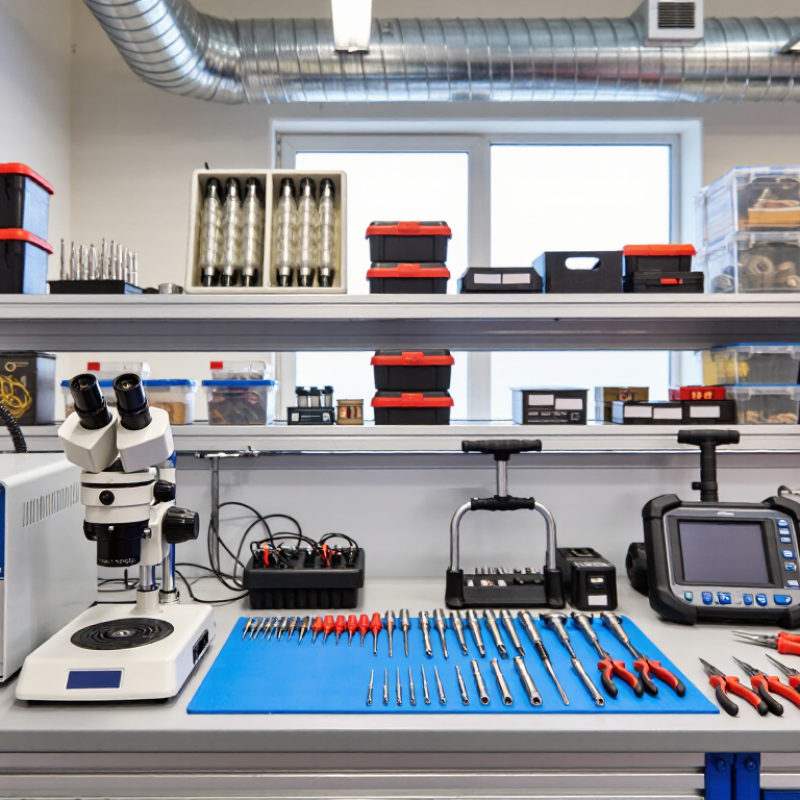
Choosing the best Repair Equipment from China requires more than comparing prices on a supplier website. The right choice depends on the repair task, operating environment, technician skill, and expected workload. A mobile phone workshop may need precision screwdrivers, hot air stations, microscopes, and battery testers. An automotive service center may require diagnostic scanners, hydraulic lifts, welders, and calibrated measuring tools. The equipment must match real working conditions.
Experience shows that reliable purchasing begins with practical questions. Can the supplier provide test reports, user manuals, spare parts, and clear warranty terms? Are replacement heating elements, probes, cables, or seals easy to obtain? A polished product page is not proof of quality. Factory audits, sample testing, and customer references offer stronger evidence. Buyers should also check electrical safety, material durability, calibration procedures, and compatibility with local systems.
There is no single best option.
Some Chinese manufacturers produce excellent professional equipment, while others focus mainly on low prices. Even experienced buyers can miss hidden weaknesses, such as unstable temperature control or poor after-sales support. A sample may perform well during testing but fail after months of daily use. That possibility deserves attention. The most trustworthy decision combines hands-on evaluation, technical documentation, transparent communication, and total ownership cost. When these details are reviewed carefully, Chinese Repair Equipment can provide practical performance, scalable supply, and reasonable long-term value for qualified businesses.
What Is the Best Repair Equipment from China?
Types of Repair Equipment Manufactured in China
China manufactures a wide range of repair equipment for automotive, electronics, industrial, and household applications. Automotive workshops often use vehicle lifts, tire changers, wheel balancers, diagnostic scanners, and battery testers. These machines support routine inspections and practical repairs.
Electronics technicians can find soldering stations, hot-air rework tools, microscope systems, ultrasonic cleaners, and programmable power supplies. Industrial repair facilities commonly use hydraulic presses, air compressors, welding machines, and electric motor testing equipment. Many manufacturers also produce compact tools for mobile technicians and small workshops.
In real workshop use, reliable performance depends on more than price. I would check lifting capacity, measurement accuracy, electrical protection, and replacement-part availability. Clear manuals matter too. Small details matter.
Some low-cost machines look impressive but feel less stable during repeated operation. I have seen inaccurate gauges create unnecessary rework. That risk deserves attention. Buyers should request test records, inspect sample units, and confirm calibration procedures before placing large orders. Independent quality inspections can improve confidence, especially when equipment requires precise readings or carries heavy loads. The best choice is not always the cheapest model. It should match the repair task, operator skill, workspace, maintenance plan, and local safety requirements.
Typical rated motor power by repair-equipment type
Hydraulic presses and welding machines generally require higher power because they perform force-intensive or heat-intensive work. Battery testers, tire changers, and pipe-cutting machines usually operate with lower power requirements. The best equipment depends on the repair task, material, workload, and required precision. Values shown are representative rated-power levels commonly found in industrial repair equipment; actual specifications vary by model and capacity.
Choosing the best repair equipment from China requires more than comparing prices. The right choice depends on performance, safety, service, and measurable consistency. I once focused too heavily on a low quotation. The equipment looked solid, but its calibration records were incomplete. That experience changed my evaluation process.
Start with the equipment’s intended workload. Check torque range, operating temperature, power stability, and compatible replacement parts. Ask for test data under conditions close to your workshop. Short demonstrations can hide problems. Request repeated cycle testing instead. Examine the frame, cables, switches, and protective covers by hand. Small weaknesses often appear there first.
Technical documentation also matters. Reliable suppliers should provide clear manuals, maintenance schedules, wiring diagrams, and traceable inspection reports. Confirm whether technicians receive practical training. Ask how quickly spare parts can be supplied and how service cases are recorded. Independent conformity documents may support credibility, but they should match the equipment and target market. A certificate alone proves little.
I also recommend testing one unit before ordering in volume. Record noise, heat, accuracy, setup time, and failure points. Speak with users who operate similar equipment daily. Their feedback may reveal inconvenient software or fragile accessories. My own assessment is never perfect. Workshop conditions differ, and early assumptions can mislead. That is why a written trial plan remains essential.
What Is the Best Repair Equipment from China?
Choosing repair equipment depends on the job, not the country of origin. Electronics work needs a temperature-controlled soldering station, magnification, and stable power output. Automotive repair requires torque tools, diagnostic equipment, and lifting capacity matched to the vehicle. Hydraulic applications need pressure-rated test equipment, accurate gauges, and durable seals.
In my experience, repair shops often focus on price first. That can create expensive delays later. Check the equipment’s working range, materials, calibration method, and replacement-part availability. Ask for test reports, user manuals, warranty conditions, and operator training. For imported equipment, confirm voltage, plug type, packaging strength, and technical support. A sample unit can reveal noise, heat buildup, or poor finishing that photos hide. I once underestimated workspace size, and daily movement became frustrating. That mistake still influences my buying checklist.
Tips: Match the tool to the repair task. Measure your workspace before ordering. Request a real operating video. Test accuracy with a known reference. Keep safety guards in place. Do not trust impressive specifications without practical evidence. For busy workshops, choose serviceable equipment with simple controls. For occasional repairs, compact equipment may be more sensible. Review calibration records regularly, because accuracy can decline quietly. Ask experienced technicians to inspect the equipment before final payment. Their criticism may expose weaknesses that a sales description misses.
| Repair Application | Typical Problems | Recommended Equipment | Important Specifications | Suitable Materials or Components | Advantages | Limitations and Safety Notes | Selection Priority |
|---|---|---|---|---|---|---|---|
| PCB soldering and component replacement | Loose joints, damaged through-hole parts, connector replacement, wire repair | Temperature-controlled soldering station | Adjustable temperature around 200–480°C; interchangeable tips; fast thermal recovery; ESD-safe design | Lead-free solder, copper pads, wires, connectors, resistors, capacitors and integrated circuits | Precise heat control, low operating cost and suitable for daily bench work | Excessive heat can lift PCB pads or damage sensitive components. Use ventilation and ESD protection. | Very high |
| Surface-mounted device rework | Replacement of QFP, QFN, SOIC, diode, capacitor and other surface-mounted components | Hot-air rework station | Adjustable airflow and temperature; stable nozzle heating; temperature range commonly up to about 500°C | Surface-mounted components, solder paste and lead-free solder alloys | Allows localized heating without direct contact and supports multiple nozzle sizes | Airflow that is too strong may move small components. Shield nearby parts and avoid overheating the PCB. | Very high |
| Fine-pitch inspection and micro-soldering | Bridged solder joints, cracked pads, trace damage and hidden mechanical defects | Stereo inspection microscope with LED illumination | Typical magnification of approximately 7×–45×; adjustable working distance; ring light or coaxial lighting | Printed circuit boards, connectors, flex cables and miniature electronic assemblies | Provides depth perception and reduces eye strain during precision work | Magnification alone does not improve image quality. Stable focusing, lighting and sufficient working distance are essential. | Very high |
| Power testing and fault isolation | Short circuits, abnormal current draw, unstable voltage and intermittent startup failures | Adjustable DC laboratory power supply | Constant-voltage and constant-current modes; adjustable current limit; low ripple; isolated output preferred | PCBs, embedded systems, consumer electronics and low-voltage battery-powered devices | Controlled power delivery helps prevent additional damage during diagnosis | Confirm the device voltage and polarity before connection. Do not use a current-limited supply as a substitute for a battery-management system. | Very high |
| Signal measurement and electronic diagnosis | Missing clocks, distorted waveforms, communication faults and switching-power problems | Digital storage oscilloscope | Bandwidth should exceed the highest signal frequency of interest; adequate sample rate, memory depth and probe compensation | Digital circuits, motor controllers, power supplies, communication interfaces and sensors | Displays transient events and timing relationships that a multimeter cannot capture | Incorrect grounding can create short circuits or unsafe conditions. Use suitable probes and observe voltage ratings. | High |
| Continuity, resistance and basic component checks | Open circuits, short circuits, incorrect resistance and diode or fuse failure | True-RMS digital multimeter | Accurate DC and AC voltage measurement, resistance, continuity, diode test and capacitance functions | Wiring, fuses, resistors, diodes, connectors and low-voltage electronic circuits | Portable, versatile and suitable for initial inspection and final verification | Verify the measurement category rating and test-lead condition. Discharge capacitors before resistance or continuity testing. | Essential |
| PCB cleaning after soldering or contamination | Flux residue, dust, oil, oxidation and conductive contamination | Ultrasonic cleaner with adjustable timer and temperature | Stainless-steel tank; frequency commonly around 35–45 kHz; adjustable cycle time; compatible cleaning solution | Metal tools, removable circuit boards and selected water-resistant assemblies | Reaches small gaps and areas that are difficult to clean with a brush | Remove batteries, speakers, displays and moisture-sensitive parts before cleaning. Thorough drying is mandatory. | Medium to high |
| Battery testing and charging diagnosis | Reduced capacity, high internal resistance, charging failure and abnormal discharge | Programmable battery analyzer or electronic load | Controlled charge and discharge modes; adjustable current; capacity recording; over-voltage and over-temperature protection | Rechargeable battery packs and cells within the tester’s voltage and current range | Produces repeatable capacity and discharge data instead of relying only on open-circuit voltage | Use cell-specific procedures and protective enclosures. Never test swollen, leaking or mechanically damaged cells. | High for battery repair |
| Thermal fault detection | Overheating components, shorted areas, poor heat transfer and abnormal current paths | Infrared thermal camera or thermal imaging attachment | Suitable thermal sensitivity, adjustable emissivity, adequate spatial resolution and temperature range for electronics | Power boards, motor drivers, adapters, battery systems and densely populated PCBs | Quickly identifies temperature differences without physical contact | Shiny metal surfaces can give misleading readings. Confirm suspected faults with electrical measurements. | High for intermittent faults |
| Wire, cable and connector repair | Broken conductors, damaged insulation, loose terminals and poor crimp connections | Wire stripper, precision crimping tool and heat gun | Correct wire-size range; controlled crimp profile; adjustable heat; suitable hot-air nozzle | Hook-up wire, cable harnesses, insulated terminals, heat-shrink tubing and connectors | Creates consistent mechanical connections and protects repaired joints from abrasion and moisture | Use the correct terminal and die for the conductor size. Avoid overheating insulation or sealing contaminated joints. | High |
| Mechanical repair of electronic housings | Stripped screws, broken plastic clips, damaged covers and worn fasteners | Precision driver set, torque screwdriver and controlled hot-air tool | Compatible bit profiles; adjustable torque; low-temperature control for plastic components | Plastic housings, small fasteners, brackets and consumer-electronics enclosures | Reduces stripped screws and helps prevent damage during disassembly and reassembly | Use the correct bit size and torque. Excessive heat can deform plastics and weaken structural parts. | High |
| General workshop protection | Electrostatic discharge, fumes, poor organization and accidental contact with live parts | ESD work mat, wrist strap, fume extractor and insulated safety accessories | Verified grounding path; suitable filtration; antistatic surface resistance; adequate airflow | Electronic assemblies and repair benches handling sensitive semiconductor devices | Protects components and improves operator safety and work consistency | ESD equipment must be correctly grounded and periodically checked. Fume extraction does not replace general ventilation. | Essential |

What Is the Best Repair Equipment from China?
Quality, safety, and certification standards matter more than a low purchase price. The best equipment should perform consistently under daily workshop pressure. Check the frame, switches, cables, moving parts, and surface finish. Loose handles or uneven welds can reveal weak production control.
Ask for factory test records, not only attractive certificates. Confirm the certificate number, issuing body, product model, test date, and covered voltage range. ISO 9001 may show quality management, but it does not prove every machine is safe. Electrical equipment should meet applicable safety and electromagnetic compatibility requirements. Depending on the product, relevant IEC standards and CE documentation may also be necessary. Always verify the scope.
Details matter. A lifting device needs overload protection and a clearly marked emergency stop. A powered tool should have reliable grounding, insulation protection, and heat control. Calibration records are essential for torque tools, pressure gauges, and diagnostic instruments. Request serial-number traceability and replacement-part information before ordering. Inspect the packaging too. Damaged corners can hide internal failures.
A certificate can be outdated.
Ask for a sample unit when possible. Test noise, vibration, temperature, accuracy, and shutdown response. I would also compare the manual with the actual controls, because mismatches create avoidable risks. No checklist is perfect. My own inspection priorities may change after field use, especially when operators report awkward maintenance access or unclear warning labels. Reliable suppliers accept these questions and provide evidence without pressure.
The best Chinese repair equipment is not always the cheapest option. Choose tools with modular parts, clear manuals, calibration records, and available replacement components. A service engineer should inspect sample units before placing a large order. Check voltage, connector types, working temperature, and safety documentation. Small omissions become expensive later. In field testing, a slightly heavier unit often survives daily workshop handling better. I would still avoid judging quality from appearance alone.
Shipping requires more than comparing factory prices. The World Bank’s Logistics Performance Index 2023 ranked China 19th, with an overall score of 3.7 out of 5. That performance supports reliable logistics, but delays can still occur at customs or during inland delivery. Request reinforced packaging, moisture protection, serial-number lists, and photographs before dispatch. UNCTAD reports that more than 80% of global merchandise trade moves by sea, so sea freight usually reduces cost for heavy equipment. Air freight suits urgent parts, not bulky machines.
Maintenance should be planned before installation. Keep replacement fuses, sensors, cables, and wear components on site. The Global E-waste Monitor 2024 recorded 62 million tonnes of electronic waste in 2022, while only 22.3% was formally collected and recycled. Repair equipment should therefore support component replacement, not disposable assemblies. Record operating hours and calibration dates digitally. This sounds simple. It is often missed. Some buyers overestimate local technicians and underestimate training time, which can weaken an otherwise sound purchase.