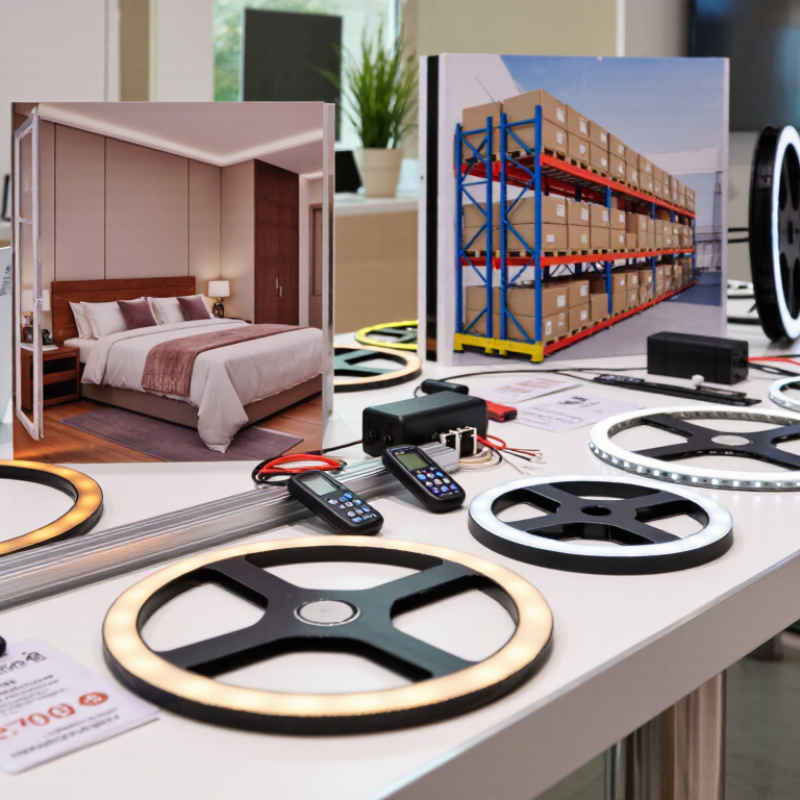
| Product Type | Flexible LED strip light for architectural, retail, hospitality, residential, or signage use. | Indoor Outdoor Neon flex High-density | Product datasheet, technical drawings, sample photos, and test sample. | Usually quoted per metre or per 5-metre reel; price depends on LED density, coating, voltage, and control features. | Confirm carton dimensions, reel length, gross weight, and pallet quantity before requesting freight rates. | Does the delivered product match the stated LED count, wattage, colour temperature, and reel length? |
| Input Voltage | Use a voltage suitable for the installation length and local electrical system. | 5 V DC 12 V DC 24 V DC 48 V DC | Electrical test report, power-supply specification, and wiring diagram. | 24 V products are often preferred for longer runs because voltage drop is generally easier to manage than with 5 V products. | Power supplies may be shipped separately and can affect customs classification, weight, and freight cost. | What is the maximum recommended continuous run before power injection is required? |
| LED Density and Light Output | Compare LED count, power consumption, luminous flux, and spacing together rather than LED count alone. | 30 LEDs/m 60 LEDs/m 120 LEDs/m COB | LM-80 data where available, integrating-sphere report, photometric file, and product test report. | Higher-density and COB designs generally cost more because of additional LEDs, materials, and production controls. | Request the packed wattage and quantity per carton; these are needed for accurate air or sea freight calculations. | Is the claimed brightness measured at the stated input voltage and operating temperature? |
| Colour and Colour Quality | Select colour temperature, colour rendering, colour consistency, and colour tolerance according to the project. | 2700–3000 K 4000 K 5000–6500 K RGB/RGBW CRI ≥80/90 | Colour test report, CCT and CRI data, binning information, and sample approval record. | Higher CRI, tighter colour tolerance, tunable white, and addressable control normally increase cost. | For mixed production batches, request colour consistency controls and an approved golden sample. | What CRI, CCT tolerance, colour bin, and lumen-maintenance data are guaranteed in the purchase contract? |
| Ingress Protection | Choose the protection level according to exposure to dust, moisture, cleaning, and weather. | IP20: dry indoor IP65: surface protection IP67: temporary immersion IP68: manufacturer-defined conditions | IP test report based on IEC 60529; installation instructions and sealing requirements. | Silicone-coated or fully enclosed products generally cost more than uncoated indoor strips. | Confirm whether connectors, end caps, power supplies, and cable joints have the same IP rating as the strip. | Does the IP rating apply to the complete installed system or only to the strip body? |
| Electrical Safety and EMC | Match the product and power supply to the destination market and intended installation environment. | SELV low voltage EMC-tested Flicker assessment Thermal test | Electrical safety report, EMC report, declaration of conformity, power-supply documents, and user instructions. | Independent testing and compliant power supplies can add testing and documentation costs but reduce market-entry risk. | Check whether the importer or distributor must be named as the responsible economic operator in the destination market. | Are the strip light and its power supply tested as a compatible system? |
| European Union Requirements | Products placed on the EU market may require compliance with applicable electrical, EMC, chemical, and energy rules. | CE marking RoHS REACH information WEEE obligations | EU Declaration of Conformity, EMC and safety reports, RoHS evidence, REACH declarations where relevant, and technical file support. | Testing and documentation fees vary by product configuration and whether the power supply is included. | Agree who handles importer responsibilities, extended producer responsibility registration, and local waste obligations. | Are the documents issued for the exact model, voltage, power supply, and product revision being purchased? |
| United Kingdom Requirements | Confirm current UK product-marking and importer requirements for the intended sales channel. | UKCA where applicable CE acceptance may apply in some cases UK RoHS | UK Declaration of Conformity or applicable conformity documentation, technical records, and importer details. | Cost depends on whether UK-specific documentation is needed in addition to existing EU documentation. | Clarify the importer of record and delivery terms for shipments entering Great Britain or Northern Ireland. | Has the supplier checked the marking rules that apply to the exact product category and destination? |
| United States and Canada | Check market-specific requirements for LED equipment, power supplies, radio controls, and electromagnetic emissions. | FCC Part 15 for applicable electronics UL/CSA certification where required State or local code review | FCC compliance records where applicable, recognised safety certification, electrical ratings, and installation instructions. | North American safety certification may increase tooling, testing, marking, and documentation costs. | Confirm whether the product is intended for direct retail sale, project supply, or installation by a licensed contractor. | Does the certification cover the complete assembly, including the driver, controller, connectors, and enclosure? |
| Supplier Type | Choose the supplier structure that matches volume, customisation, lead-time, and after-sales requirements. | Manufacturer Contract manufacturer Distributor Trading supplier | Factory audit records, quality system evidence, sample-production records, and traceability procedure. | Direct manufacturing can be more competitive at higher volume; distributors may provide lower minimum order quantities and faster delivery. | Ask whether the quoted party is the legal seller, manufacturer, exporter, or purchasing intermediary. | Who controls component changes, warranty decisions, production records, and corrective actions? |
| Minimum Order Quantity | Negotiate MOQ by model, colour, voltage, PCB width, coating, reel length, and packaging design. | Sample order Small batch Project volume OEM batch | Written quotation showing MOQ, sample fee, tooling fee, packaging fee, and refund conditions. | Custom PCB colours, private packaging, special connectors, and custom lengths usually require higher MOQs. | Confirm whether partial shipment is allowed and whether the balance can be shipped with a later production batch. | What costs remain if the buyer orders samples but does not proceed to mass production? |
| Indicative Product Pricing | Compare like-for-like specifications: voltage, watts per metre, LED density, CRI, IP rating, copper weight, and accessories. | Basic indoor High-density Outdoor sealed Addressable | Formal quotation with currency, validity period, Incoterm, packaging, payment schedule, and specification attachment. | Indicative bulk export ranges: basic indoor strips about USD 0.80–3.00/m; higher-density or high-CRI strips about USD 2.00–8.00/m; sealed or advanced addressable products may exceed USD 5.00–15.00/m. | Product price excludes or includes freight depending on the Incoterm. Always request a landed-cost comparison. | Are the quoted prices based on the same reel length, accessories, test requirements, and packaging configuration? |
| Power Supply and Controls | Size the driver for actual load, starting current, ambient temperature, ventilation, and dimming method. | Constant-voltage driver PWM dimming DALI DMX Wireless control | Driver safety and EMC documents, efficiency data, overload protection, and compatibility test report. | Drivers and controllers can represent a substantial part of system cost, especially for tunable or addressable installations. | Ship sensitive electronics with moisture protection and shock-resistant packaging; verify dangerous-goods requirements where relevant. | What is the recommended reserve capacity, and has the controller been tested with the final strip length? |
| Quality Control | Use documented incoming, in-process, ageing, electrical, optical, and final inspection procedures. | 100% function test Burn-in test Voltage-drop test Colour inspection | Inspection plan, sample inspection report, batch code, corrective-action record, and pre-shipment inspection option. | Third-party inspection commonly adds a service charge but can reduce disputes on large orders. | Define inspection timing, acceptable quality limits, packaging checks, and release conditions before shipment. | Can every carton and production batch be traced back to component lots and inspection records? |
| Packaging | Protect reels, connectors, coatings, and power supplies from crushing, moisture, electrostatic damage, and incorrect labelling. | Individual reel box Master carton Palletised export pack Retail packaging | Packaging specification, carton marks, barcode requirements, pallet details, and packing list. | Custom retail packaging and colour printing increase unit cost and may require a packaging MOQ. | Confirm carton drop-test expectations, pallet treatment requirements, container loading plan, and moisture protection. | Are product labels, carton marks, country-of-origin statements, and safety warnings suitable for the destination? |
| Lead Time | Separate sample lead time, production lead time, inspection time, and transit time. | Samples: often 3–10 working days Standard production: often 10–30 working days Custom projects: longer | Order acknowledgement, approved sample, production schedule, and shipment release procedure. | Rush production, custom tooling, special components, and peak-season capacity can increase cost and lead time. | Transit time is separate from production time; include customs clearance and final-mile delivery in the project plan. | What event starts the production clock: deposit receipt, drawing approval, or sample approval? |
| Incoterms | Choose the term according to the buyer’s logistics capability, risk tolerance, and customs responsibilities. | EXW FCA FOB CIF/CIP DAP DDP only after tax review | Quotation showing named place or port, Incoterms® 2020 rule, insurance responsibility, and export documents. | Delivered prices can appear higher because they include freight, insurance, customs services, duties, taxes, or local delivery. | For containerised cargo, FCA is often more precise than FOB when goods are handed to a carrier before loading on board. | Who bears risk, freight, import clearance, duty, VAT or sales tax, and delivery charges at each stage? |
| Freight Method | Select transport based on urgency, shipment size, budget, and destination infrastructure. | Courier: samples Air freight: urgent batches Sea freight: large volume Rail or multimodal: route-dependent | Commercial invoice, packing list, transport document, certificate of origin where needed, and export declaration. | Freight rates vary with fuel, season, route, chargeable weight, port congestion, and destination surcharges. | Compare total landed cost, not only freight price; include customs brokerage, destination handling, storage, and final delivery. | Is the freight quote based on actual weight, volumetric weight, container volume, or a minimum charge? |
| Payment and Commercial Protection | Use a payment structure that protects both production commitment and buyer inspection rights. | Deposit and balance Letter of credit Escrow where available Milestone payment | Signed purchase order, pro forma invoice, bank-account verification, warranty terms, and dispute-resolution clause. | Payment fees, inspection fees, tooling deposits, and currency conversion costs should be shown separately. | Do not rely only on a messaging-app payment instruction; independently verify beneficiary details before remitting funds. | Can the balance payment be linked to inspection approval, shipment evidence, and complete export documentation? |
| Warranty and After-Sales | Define warranty duration, operating conditions, exclusions, replacement process, and evidence requirements. | Product warranty Driver warranty Batch replacement Spare-parts support | Written warranty policy, failure-rate procedure, return-material process, and technical support contact. | Longer warranty commitments may be reflected in product selection, component quality, testing, and reserve pricing. | Agree who pays for return freight, replacement freight, customs charges, and on-site labour. | Does the warranty remain valid when the strip is installed with a third-party driver or controller? |
| Sustainability and End-of-Life | Review material composition, energy efficiency, repairability, packaging, and recycling responsibilities. | RoHS evidence REACH information Recyclable packaging Replaceable driver | Material declarations, restricted-substance evidence, packaging composition, and applicable producer-responsibility documents. | Higher efficiency, better thermal design, and recyclable packaging can change purchase price but may reduce lifecycle cost. | Confirm destination-country requirements for electrical equipment waste, batteries, packaging, and importer registration. | Can the supplier provide documented material and recycling information for the exact shipment configuration? |